
By Orit Naomi and Dustin Stone, RTN staff writers - 8.1.2026
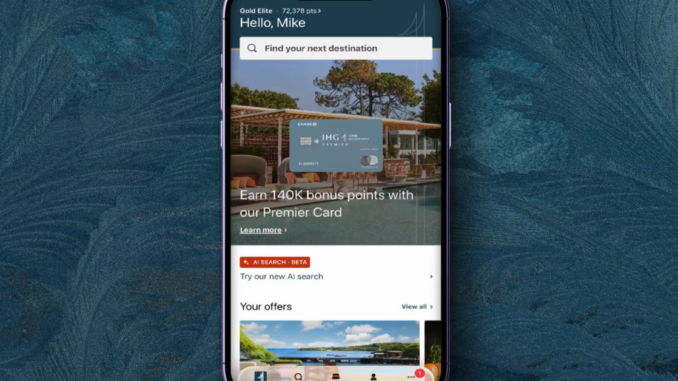
IHG Hotels & Resorts has launched conversational hotel search across IHG.com and the IHG One Rewards mobile app, allowing travelers to describe a trip in everyday language rather than begin with a destination and a fixed set of filters.
The beta became available in the United States on July 28 and is expected to expand into additional markets after IHG studies user behavior and feedback. Traditional hotel search remains available alongside the new tool, giving travelers the option to move between conversational prompts and the familiar destination-and-date format.
A traveler can describe the purpose of a trip, preferred amenities or the type of experience being planned. IHG’s system then returns hotel recommendations with interactive maps, current pricing, real-time availability and detailed property information. Recommendations draw on IHG’s verified hotel data and guest reviews rather than relying exclusively on material gathered from the open web. Guests can search using cash rates, loyalty points or a combination of points and cash. That connection to live inventory and IHG One Rewards gives the tool a practical role in the booking process, rather than limiting it to broad travel inspiration.
The launch changes the starting point of an IHG hotel search. Instead of selecting Chicago, entering dates and working through filters, a traveler could ask for a quiet hotel suitable for a weekend anniversary trip, a family property with a pool near a particular attraction or a business hotel with meeting space and easy airport access. The system must interpret the request, identify which details are requirements and decide which hotels within IHG’s portfolio are most relevant. Maps, property pages and conventional booking tools then take over as the guest narrows the choices and completes the reservation.
That combination is likely to be more useful than replacing the entire booking process with a chat window. Conversation works well when a traveler is still defining the trip, while photographs, rates, maps and side-by-side comparisons remain important once the shortlist has been established. The beta covers more than 7,000 IHG hotels in over 100 countries. IHG’s portfolio spans 21 brands, ranging from Holiday Inn Express, Candlewood Suites and Garner to InterContinental, Regent, Kimpton and Six Senses. The company also has more than 160 million IHG One Rewards members.
That scale creates both an opportunity and a search problem. A large brand portfolio gives travelers more options, but it can be difficult to understand which flag, property type or location best fits a particular occasion. Conversational search can translate a loosely defined need into a smaller group of relevant choices without requiring the guest to understand every brand in advance.
IHG has already opened another route into the same portfolio. On June 3, the company launched an IHG app in ChatGPT, allowing users to search and compare its hotels from within a ChatGPT conversation. The app displays live availability, prices, amenities, interactive maps and hotel recommendations before directing the traveler to IHG’s own channels to complete the booking. The two launches give IHG a presence both inside its own digital environment and on a third-party AI platform. That balance may become increasingly important as travelers begin trip planning in a wider range of places.
A guest who already uses ChatGPT for destination research may prefer to begin there. A loyalty member who opens the IHG app may want a similar conversational experience without leaving the company’s ecosystem. IHG can participate in both journeys while keeping the final reservation inside its direct booking infrastructure.
The approach also reflects a larger distribution concern. Hotel companies spent years trying to reduce dependence on online travel agencies and encourage guests to book through brand websites and loyalty apps. General-purpose AI assistants now have the potential to become another influential layer between the traveler and the hotel.
IHG’s ChatGPT presence acknowledges that travelers may not always begin on IHG.com. Its new website and app search, however, gives the company a reason to keep them there once they arrive. The owned-channel experience allows IHG to control the property information being presented, incorporate current rates and availability and make loyalty currencies part of the search. It also avoids placing competing hotel groups in the same results list.
An independent AI assistant might compare an InterContinental with a Marriott, Hilton or independent hotel. IHG’s own search is designed to find the best match within IHG’s portfolio. That limitation is useful to the company, although travelers may still move to broader search tools when they want to compare brands. Hotel content will play a larger role as these systems mature. IHG plans to introduce an AI-optimized content platform over the next several months, making it easier for hotels to upload more detailed property information, updated imagery, videos and floor plans. The material is intended to improve hotel visibility in both IHG-operated search and third-party AI channels.
For owners, that platform may prove as consequential as the consumer search interface. An AI system cannot reliably recommend a property for connecting rooms, a pet-friendly stay, a rooftop gathering or a particular accessibility requirement unless those attributes are accurately documented.
Traditional hotel search has relied heavily on location, price, brand and a relatively short list of amenities. Conversational search expands the number of questions a traveler can ask. A guest may care about the atmosphere of the surrounding neighborhood, the layout of a suite, parking for a large vehicle, the walking distance to a specific venue or whether a hotel works well for a multigenerational family. The quality and structure of the property record will determine whether the system can answer those questions.
Incomplete content could reduce a hotel’s visibility even when the property is otherwise a good match. Detailed, current information may help hotels surface for travel needs that would be difficult to capture through standard filters. That gives individual owners a more direct role in AI search performance. Search visibility will depend not only on brand strength and revenue-management decisions, but also on whether the hotel has supplied accurate descriptions, amenity details and visual material.
The ability to upload floor plans is particularly notable. Room categories often reveal little about how a space actually works for a family, business traveler or extended-stay guest. A system that understands layout information could eventually answer more specific questions about adjoining spaces, work areas, sleeping arrangements and accessibility. IHG has not said exactly how the new content will be structured, ranked or weighted within its recommendation system. Owners will want greater visibility into those mechanics as conversational search begins influencing meaningful booking volume.
The competitive field is developing quickly. Hilton introduced the Hilton AI Planner on March 10. The tool sits inside Hilton.com and allows travelers to explore destinations, compare properties and search for amenities through a conversational interface. It began with limited traffic and became available to all Hilton.com visitors using desktop or tablet devices on March 17. Hilton’s approach remains centered on its owned website. Like IHG, it is using the beta period to study how travelers interact with conversational search and refine the experience before pursuing deeper personalization.
Marriott International followed on June 16 with Ask Bonvoy. The beta is available in U.S. English on Marriott.com and the Marriott Bonvoy iOS and Android apps to a subset of members and newly enrolled users. Marriott plans a broader global rollout later in 2026. Ask Bonvoy uses Marriott’s proprietary AI architecture and grounds its responses in Marriott-owned, verified hotel data. It identifies the purpose of a trip and searches the company’s portfolio based on preferences involving location, dining, spas, golf and other amenities. Once a traveler selects a property, the experience hands the reservation back to Marriott’s established booking system. Marriott expects to support loyalty-points searches later.
IHG’s current beta goes a step further on loyalty shopping by supporting cash, points and points-plus-cash searches from the outset. It is also available through both the IHG One Rewards app and IHG.com while maintaining a separate presence in ChatGPT.
Radisson Hotel Group announced another variation on July 28. Working with Accenture, Radisson launched a branded app inside ChatGPT that searches more than 1,000 hotels in over 100 countries. The app returns live inventory, rates, amenities, hotel details and map-based results before directing travelers to Radisson’s website to reserve. Radisson plans to add loyalty recognition, deeper personalization, in-chat booking, reservation management and trip-modification capabilities over time. Those functions are not yet part of the current experience.
These launches illustrate the choices facing hotel companies. Hilton and Marriott have placed their initial conversational tools primarily inside owned channels. Radisson has entered through ChatGPT. IHG is doing both.
No single approach has yet demonstrated a clear advantage. The answer will depend on where travelers prefer to begin, how often AI recommendations convert into bookings and whether participation in an outside assistant brings incremental demand or merely shifts traffic away from hotel websites. Owned-channel tools offer control. The hotel company determines which data is used, how loyalty is incorporated and where the customer completes the booking. It also retains more information about the search process and the preferences expressed during the conversation.
Third-party AI platforms offer reach. A traveler may use one assistant to explore destinations, compare transportation, choose activities and find a hotel. Requiring that person to begin a separate conversation on every hotel company’s website may be unrealistic. The tradeoff resembles the industry’s longstanding relationship with online travel agencies, but conversational AI may narrow the field more aggressively. An OTA results page can display dozens of properties. An assistant may recommend only three or four.
That makes inclusion in the first answer more valuable and exclusion potentially more damaging. Hotel companies and owners will need to understand what makes a property eligible for those shortlists. The answer is likely to involve far more than conventional search-engine optimization. AI systems need current rates, room availability, detailed amenities, accurate location data and content that explains which travelers and occasions a hotel serves well.
IHG’s new content platform appears designed with that change in mind. It gives hotels a way to provide richer material that can be used across the company’s search system and outside AI environments. The operational burden should not be underestimated. IHG’s hotels are largely owned and operated by franchisees and other third parties. Maintaining consistent, detailed information across more than 7,000 properties will require clear standards, usable content-management tools and ongoing oversight. Incorrect information can create more than a poor search result. If a conversational system tells a guest that a hotel has a shuttle, accepts a particular type of pet or offers a room configuration that is unavailable, the error becomes an on-property service problem. Grounding recommendations in verified hotel data reduces the risk of unsupported answers, but only when the underlying information is complete and current. The quality of the AI experience will therefore depend heavily on work performed well before the customer enters a prompt.
IHG is also developing more personalized search and what it calls agentic booking capabilities. Those features could eventually allow a system to use known preferences and take a larger role in selecting and reserving a stay. They remain on the company’s development roadmap rather than part of the July beta.
Personalization could give hotel brands an advantage over general-purpose tools. An IHG One Rewards member’s past stays, preferred brands and use of points could help produce more relevant results than a search based only on the current prompt. The use of loyalty data will also require restraint. Travelers may appreciate recommendations informed by previous behavior, but they will expect clear control over which information is used and how strongly it shapes the choices presented.
Agentic booking presents an even larger shift. Today’s tools help travelers explore and then hand them to a conventional reservation process. A future agent could search, compare, apply loyalty preferences and complete the transaction with less direct involvement from the guest. Before that model becomes widely accepted, hotel companies will need dependable identity controls, payment authorization, cancellation handling and confirmation that the system selected the room and rate the traveler intended.
For now, IHG’s launch is more grounded. The tool helps guests explain what they want and uses live hotel information to produce a manageable set of options. The traveler remains responsible for reviewing the choices and completing the reservation. The immediate measure of success will not be how fluently the system holds a conversation. IHG will need to determine whether it helps travelers find suitable hotels faster, introduces them to properties they would otherwise miss and produces more completed direct bookings. Owners will be watching another set of results: whether better content leads to greater visibility, whether conversational referrals convert at attractive rates and whether the system favors properties for reasons they can understand and influence.
Conversational interfaces are becoming common across the largest hotel groups, so the presence of an AI search box will not remain a competitive distinction for long. The differences will emerge in the accuracy of the answers, the quality of the underlying property data and the transition from recommendation to reservation. IHG now has both an owned-channel search experience and an entry point through ChatGPT. Its next challenge is making sure those routes generate useful matches for travelers and profitable demand for hotel owners, rather than simply adding two more places to begin the same hotel search.