
By Dustin Stone, Gavriel Shohet and Lea Mira, HTN staff writers - 6.22.2026
For hotels, coffee has become far more than a beverage. It is often one of the first experiences guests have each day and one of the last impressions they take with them before checking out. Whether served in a lobby café, breakfast venue, executive lounge, grab-and-go market or banquet setting, coffee plays an increasingly important role in guest satisfaction, brand perception and food-and-beverage revenue. As expectations continue rising, hotel operators face a growing challenge: delivering premium coffee experiences consistently across multiple properties, varying staffing levels and increasingly demanding guest expectations.
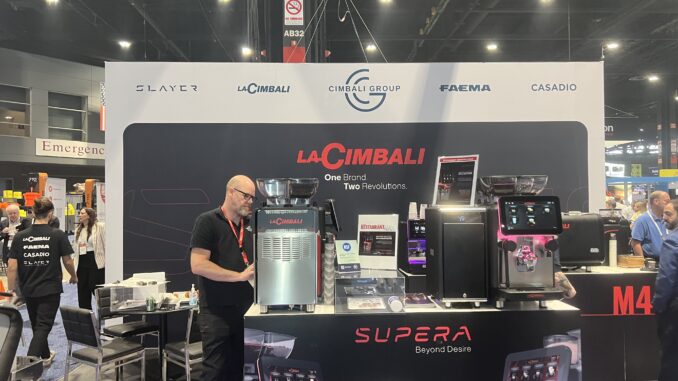
That challenge was a recurring theme at this year’s National Restaurant Association Show, where exhibitors showcased technologies designed to improve quality, consistency and operational performance throughout hospitality operations. Among them was LaCimbali, one of the world’s most recognized espresso-equipment brands. At the show, the company highlighted its latest coffee technologies and introduced Supera, a new fully automatic platform designed to combine premium beverage quality, operational flexibility and automated maintenance capabilities. The launch reinforced a message that is becoming increasingly relevant for hotel operators: delivering exceptional coffee at scale requires a combination of craftsmanship, technology and operational intelligence.
LaCimbali occupies a distinctive position within the hospitality industry because it bridges two worlds that have often been viewed as competing philosophies. On one side is the tradition of Italian espresso craftsmanship, skilled beverage preparation and coffee culture. On the other is the growing need for automation, consistency and operational scalability across large hospitality organizations. Rather than treating those concepts as mutually exclusive, LaCimbali has spent decades developing technologies designed to support both objectives simultaneously.
This balanced approach reflects broader changes taking place throughout the hotel industry. Hotels today are expected to deliver specialty-coffee experiences that rival dedicated cafés while also managing labor shortages, staff turnover and increasingly complex operations. A luxury resort, convention hotel, select-service property and airport hotel may all have different operating models, yet guests consistently expect high-quality coffee regardless of the setting. Maintaining those standards across multiple properties and service environments has become a significant operational challenge.
The importance of coffee within hospitality continues growing. Many hotel brands have invested heavily in lobby cafés, premium breakfast programs, grab-and-go markets and specialty beverage concepts. In some properties, coffee programs serve as both a revenue generator and a brand differentiator. Guests increasingly associate beverage quality with the overall quality of the hotel experience, making consistency and execution more important than ever.
LaCimbali’s portfolio reflects the diversity of modern hotel operations. The company offers traditional espresso platforms such as the M200, along with fully automatic systems including the S-Lite, S30, S60 and Supera product families. While these platforms serve different operational requirements, they share a common objective: helping hospitality organizations deliver premium coffee experiences with greater consistency, efficiency and control.
What makes this particularly relevant to hotel operators is the complexity of hospitality beverage service. Unlike traditional cafés, hotels often operate multiple coffee-service environments simultaneously. A single property may serve espresso beverages in a lobby café, breakfast service in a restaurant, specialty drinks in executive lounges and large-volume coffee service during conferences and events. Maintaining quality across those diverse settings requires more than equipment alone. It requires systems that support consistency, workflow efficiency and operational visibility.
This is where LaCimbali’s investment in connected technologies becomes increasingly important. Modern hospitality organizations are seeking operational intelligence alongside beverage quality. Through digital platforms and connected-management capabilities, operators can gain greater visibility into machine performance, beverage production, maintenance requirements and operational consistency. These insights help support quality-control initiatives while reducing the complexity associated with managing coffee programs across multiple locations.
The ability to monitor and manage equipment performance remotely is becoming increasingly valuable for hotel groups with large property portfolios. Consistency across locations has long been a challenge within hospitality. Guests expect the same quality standards whether they are visiting a flagship urban property or a resort destination. Connected coffee technologies help operators identify performance issues, standardize beverage preparation and maintain brand standards more effectively.
Labor realities further strengthen the value proposition. Hotels continue facing staffing shortages, training challenges and employee turnover across food-and-beverage operations. Coffee preparation often requires specialized knowledge, particularly when premium espresso beverages are involved. Technologies that simplify workflows, automate certain processes and support consistency can help properties maintain beverage quality even when experienced staff members are difficult to recruit or retain.
LaCimbali’s recently introduced Supera platform reflects many of these priorities. Designed for high-volume environments, the system combines beverage automation, operational flexibility and a fully automated cleaning process intended to simplify daily operations. For hotels balancing service expectations with labor constraints, technologies that reduce complexity while maintaining quality can deliver meaningful operational benefits.
Importantly, LaCimbali’s approach does not position automation as a replacement for hospitality. Instead, the company emphasizes using technology to support employees and preserve beverage quality. This distinction resonates with many hotel operators who recognize that guest experiences still depend heavily on human interaction. Automation is most valuable when it reduces operational friction and allows staff members to focus more attention on service and guest engagement.
Another factor driving investment in coffee technologies is the growing financial importance of the category. Coffee frequently represents one of the highest-margin offerings within hotel food-and-beverage operations. Improvements in beverage quality, speed of service and consistency can influence guest satisfaction, repeat business and overall revenue performance. Increasingly, hospitality organizations view coffee programs not as amenities, but as strategic business assets.
The competitive landscape includes a wide range of espresso-equipment manufacturers and automated coffee providers. LaCimbali differentiates itself through a combination of heritage, innovation and hospitality expertise. With more than a century of espresso-machine history and a long-standing presence in global hospitality markets, the company continues to evolve its technology portfolio while remaining closely associated with premium coffee culture.
Perhaps the most compelling aspect of the LaCimbali story is what it suggests about the future of hotel beverage service. The next generation of hospitality coffee programs may not be defined by a choice between craftsmanship and automation. Instead, success will likely come from combining the strengths of both. Hotels increasingly need technologies that preserve beverage quality, support employees, simplify operations and provide the consistency that guests expect.
As coffee continues evolving into a central component of the guest experience, those capabilities will become even more important. By combining Italian espresso expertise, connected technologies and operational intelligence, LaCimbali is helping hotels navigate that transition. In an industry where guest expectations continue rising and operational complexity continues growing, the ability to deliver exceptional coffee consistently may be one of hospitality’s most valuable competitive advantages.