

By Dustin Stone, Gavriel Shohet and Lea Mira, HTN staff writers - 6.23.2026
The hospitality technology industry arrived in San Antonio last week with more than another year’s worth of product updates. At HITEC 2026, the larger message was that hotel technology is becoming more operationally connected, more commercially aware and more deeply embedded in the daily work of running hotels.
Produced by Hospitality Financial and Technology Professionals, the 2026 edition of the Hospitality Industry Technology Exposition and Conference brought more than 6,100 hospitality professionals to the Henry B. González Convention Center. The sold-out exhibition floor spanned 85,000 net square feet and featured more than 400 exhibiting companies, ranging from global platform providers to emerging startups trying to solve highly specific pain points in hotel operations.

The scale of the event reinforced HITEC’s long-standing position as the world’s largest and longest-running hospitality technology conference and exhibition. But the more interesting story was not the size of the crowd or the number of booths. It was the change in tone. In past years, the dominant language of hotel technology centered on cloud migration, mobile check-in, contactless service, integration and digital transformation. Those themes were still present, but they felt less like future-facing strategy and more like the baseline. The conversation has moved on.
Across the exhibition hall, the strongest vendors were not simply promising faster workflows or cleaner user interfaces. They were showing how platforms can interpret data, recommend next steps, automate routine tasks and help staff act with better context. Property management systems are becoming more like operating hubs. Guest messaging platforms are becoming service orchestration tools. Revenue systems are becoming commercial decision engines. Back-office systems are becoming predictive management platforms. Payments, access control, connectivity and in-room technology are being pulled more tightly into the guest and staff experience.
Artificial intelligence was everywhere, as expected, but the most credible demonstrations were the least theatrical. The stronger use cases did not ask hoteliers to imagine some distant future in which AI runs the hotel. They focused instead on familiar work that already consumes too much time: assigning rooms, responding to guest questions, scoring reservation calls, qualifying group leads, translating content, monitoring revenue performance, routing service requests, reconciling invoices and surfacing financial exceptions. The show made clear that AI is starting to matter most where it disappears into the workflow.
That was the message at Oracle Hospitality, which introduced new AI capabilities in OPERA Cloud. The new Oracle OPERA Cloud Assistant brings embedded intelligence into core hotel operations, including AI-assisted room assignments, staff guidance, rate-description generation and multilingual translation. For a company with Oracle’s footprint in property management, the significance is less about any single feature than about where the AI sits. It is inside the PMS environment, close to the workflows where front desk, reservations and operations teams already spend their day.
That shift matters because the PMS category is changing. The modern PMS is no longer judged only by how well it manages reservations, rates, folios and check-ins. It is increasingly judged by how well it connects to payments, guest messaging, upselling, loyalty, housekeeping, revenue management, analytics and brand-level data environments. In that context, Oracle’s AI push is part of a much larger race to turn the PMS into a more intelligent operating layer.
The same category pressure was visible around Mews, Cloudbeds, Stayntouch, Maestro, roommaster, Agilysys, Shiji, Infor Hospitality, WebRezPro, HotelKey, innRoad, Visual Matrix, RMS Cloud and Jonas Chorum. Each approaches the market from a different position, but the direction is similar: hoteliers want cloud-based systems that reduce fragmentation, integrate cleanly, support mobility, expose better data and allow teams to work across departments without constantly switching context.
For independent hotels, that issue is especially acute. Large brands can build around centralized platforms, custom integrations and internal technology teams. Independent properties and smaller groups need many of the same capabilities without the same technical depth. Cloudbeds came to HITEC with a platform narrative focused on reducing operational fragmentation and helping properties use data more effectively. The company’s recent work with Climber RMS and its partnership with Journey point to a broader effort to give independent hotels more revenue, loyalty and guest engagement infrastructure without forcing them into a traditional brand system.
Mews, meanwhile, continued to frame hotel operations around performance, automation and open connectivity. Its message has resonated with hoteliers looking to rethink older workflows rather than simply move legacy processes into the cloud. Stayntouch emphasized its cloud PMS, large integration ecosystem and embedded AI-powered guest messaging. Maestro leaned into the needs of independent, full-service and luxury hotels, where rooms, spa, activities, gift cards and multiple revenue centers often need to work together. roommaster brought a similar independent-hotel focus, highlighting front desk, payments, housekeeping, messaging, revenue intelligence and voice automation as parts of one operating environment.
The larger enterprise players were also important to the conversation. Amadeus used HITEC to advance its hospitality AI strategy, including tools designed to help hotels participate in AI-powered booking channels and give commercial teams easier access to revenue and demand data. Its position in distribution, business intelligence and central reservation infrastructure makes Amadeus especially relevant as AI agents begin to influence how travelers search, compare, modify and book trips.
Sabre Hospitality remains another major force in hotel commerce and distribution through its SynXis platform. Sabre’s broader retailing strategy, including SynXis Retailing and the integration of operations capabilities through Nuvola, reflects an important direction for the industry: hotels are trying to move beyond selling rooms to selling experiences, add-ons, services and packages in ways that can be fulfilled operationally. The promise of hotel retailing has been discussed for years. The next phase is making it operationally realistic.
Distribution and channel management also remained central to the show, even if AI drew more of the headlines. SiteMinder, Access Hospitality, formerly SHR Group, RateGain, DerbySoft, D-EDGE Hospitality Solutions, Omniboost and Pricepoint all sit close to one of the industry’s most persistent challenges: helping hotels manage demand, distribution costs, connectivity and profitability across a more complicated booking environment. That challenge is becoming more pressing as conversational search, loyalty-driven discovery and AI-assisted travel planning begin to influence where guests start their shopping journey.
Commercial strategy vendors were busy for the same reason. Hoteliers have more data than ever, but much of it still lives in disconnected systems or static reports. Lighthouse introduced Ernest, an AI teammate designed to help revenue management, sales, marketing and distribution teams ask better questions of their data and move more quickly from analysis to action. IDeaS, Duetto, RoomPriceGenie, LodgIQ, Climber RMS by Revenue Analytics, PriceLabs and Pricepoint were part of the broader revenue-management conversation, which is expanding beyond rate optimization into commercial intelligence, forecasting transparency, automation and total revenue performance.
That expansion is overdue. Revenue management has historically focused on rooms, but hotels increasingly need to understand demand, profitability and guest value across the entire property. Restaurants, bars, spa, golf, parking, events, retail and amenities all affect the economics of a stay. The technology vendors that can connect pricing, merchandising, distribution and operational fulfillment will have a stronger argument than those that optimize only one part of the revenue picture.
The group and event segment was another area where automation looked especially practical. Canary Technologies launched an Agentic Sales Coordinator for hotel group and event sales, designed to support the journey from inquiry to confirmed booking. Group and event workflows are often still slow, manual and dependent on staff bandwidth. Faster lead qualification, more consistent follow-up and better routing can directly affect conversion. Thynk, which focuses on hospitality sales and catering built on Salesforce, also continued to push the idea that hotel sales teams need better prioritization, account intelligence and collaboration tools. Tripleseat, Event Temple, iVvy, MeetingPackage and Evention also fit into the broader discussion around meetings, catering, payments, accounting and event-driven revenue.
Guest engagement platforms also showed how AI is becoming more operational and less gimmicky. Revinate introduced Ivy, a hospitality AI decision-intelligence layer across its platform, and showcased capabilities such as automated call scoring and Revinate Chat. The focus here is not just answering guest questions. It is helping reservation teams understand call quality, improve conversion, identify coaching opportunities and maintain a stronger direct-booking channel. Cendyn brought a different but equally important angle with Wayfinder, a generative engine optimization and LLM monitoring platform designed to help hotels understand how their properties appear across AI-powered search environments.
That is a new problem for hotel marketers. For two decades, hotels optimized for search engines, metasearch platforms, OTAs, brand websites and review channels. Now AI assistants are beginning to synthesize recommendations and influence travel planning before the traveler clicks through to any hotel site. As Marriott’s Ask Bonvoy launch made clear, conversational search is quickly becoming part of the hotel commerce conversation. Hotels will need to know whether AI systems understand their property correctly, whether content is accurate and whether key selling points are being surfaced. Cendyn’s move suggests that AI visibility and content governance may become a new discipline inside hotel marketing.
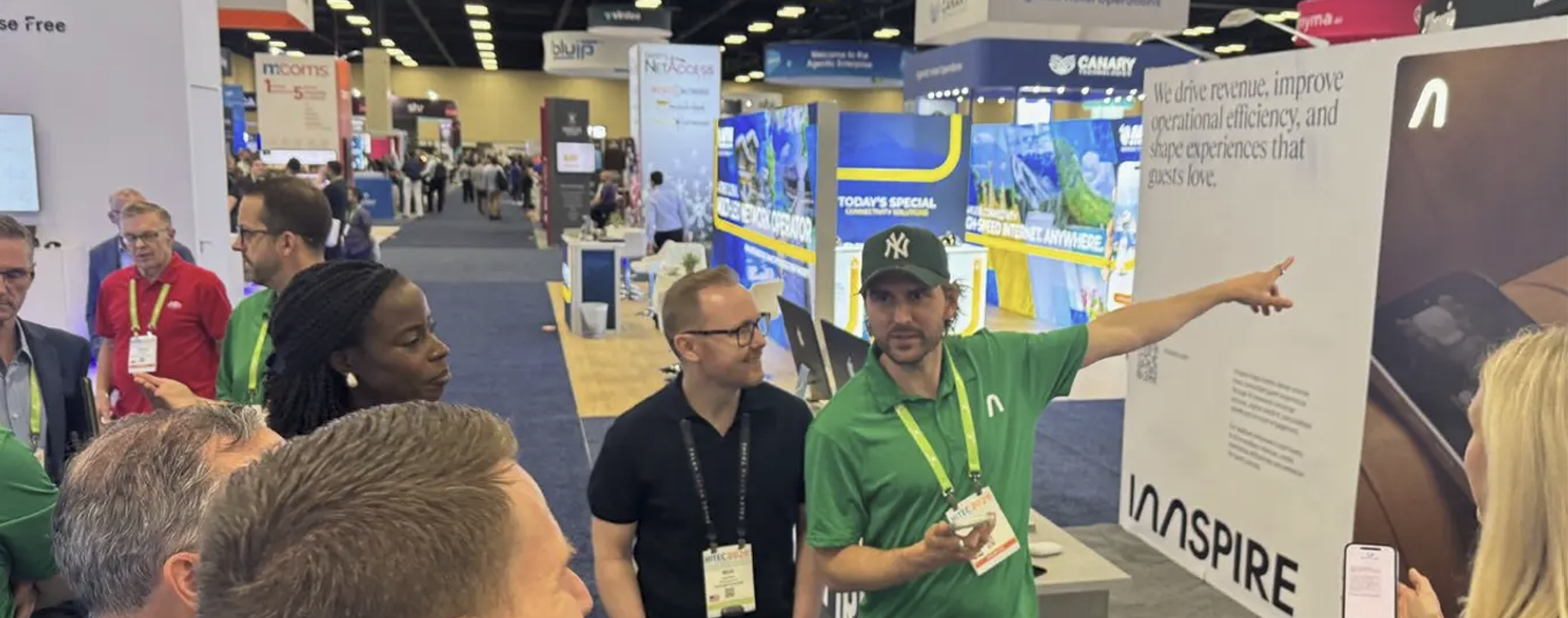
Other guest engagement vendors approached the issue from the service side. INTELITY, Innspire, HiJiffy, Akia, Duve, Virdee, Quore, Ireckonu, dailypoint, Triptease, RealTime Reservation, STAY, The Hotels Network, Flip.to, NAVIS, Myma.ai, PolyAI and Spark.ai all fit into the larger effort to connect guest identity, communication, requests, personalization, direct booking and on-property experience. Innspire officially launched Guest Flows at HITEC, reinforcing the idea that the guest journey is no longer a series of isolated touchpoints. It is a sequence of connected moments that starts before arrival and continues through the stay and beyond checkout.
This is where the industry’s language around personalization is becoming more concrete. Personalization is no longer just a CRM term or a marketing promise. It now depends on whether hotel systems can recognize the guest, understand the context, connect preferences across departments and give staff the right information at the right moment. HAPI remains a key player in that conversation because integration and data connectivity are what make personalization possible at scale. Without the connective tissue, hotels end up with more systems and the same fragmented guest view.
Hotel food and beverage technology had a stronger presence as well, partly because F&B is becoming more central to the guest experience and partly because hotels are looking for revenue beyond the room. Oracle MICROS Simphony, Agilysys InfoGenesis, Shiji Concept, Infor POS, Toast, Lightspeed, IRIS, Bbot, Olo and Uptown Network’s Artuzan reflected the same broader movement toward unified guest commerce. The future of hotel F&B technology is not only about taking orders. It is about connecting menus, payments, loyalty, inventory, guest profiles and operational capacity in ways that make the experience easier for guests and more profitable for operators.
Back-office technology also received more attention than in years past. Actabl introduced Altitude, an AI product designed to help executives ask plain-language questions about portfolio performance and receive sourced answers across financial, labor and operational data. The emphasis on sourced answers is important. Owners, asset managers and hotel executives are not looking for clever summaries. They need numbers they can trust, tied back to the systems used to manage budgets, labor and profitability.
Otelier showcased updates to TruePlan, its budgeting and forecasting platform, including tools for commentary, review and portfolio-level collaboration. Inn-Flow introduced expanded AI and automation capabilities across procurement, inventory, accounting, labor management and business intelligence. BirchStreet Systems, M3, Aptech, Sage, Prophix, Avendra, Hotel Investor Apps and Evention were part of the broader finance, procurement and accounting conversation, where automation tends to be less visible to guests but often very visible to margins.
That back-office focus may be one of the most consequential trends in hotel technology. For operators managing multiple properties, small process improvements in purchasing, forecasting, invoice management, labor tracking and financial reporting can scale quickly. These systems are not always the most glamorous part of the technology stack, but they are where owners and management companies can often find measurable gains.

Labor, housekeeping, maintenance and staff communication vendors spoke to another pressure point. Actabl, Quore, Flexkeeping, with recent deployment examples such as CLLIX Apartments & Hotels, Optii, PurpleCloud Technologies, Lodgistics, Beekeeper, Unifocus, HotSOS and Knowcross all address the same fundamental reality: hotels are being asked to deliver more consistent service with leaner teams and higher guest expectations. In this category, innovation is less about replacing staff and more about making work clearer, faster and easier to coordinate.
Access, security and physical infrastructure were also major parts of the show. dormakaba, ASSA ABLOY Global Solutions, SALTO Systems, Onity, Allegion, LEGIC, Alliants, OpenKey, FLEXIPASS and Keycafe represented a category that is evolving beyond door locks. Mobile credentials, staff key management, wallet-based room keys and cloud-based access control are becoming part of a broader discussion about digital identity and hotel operations.
The access category is a good example of how physical and digital systems are converging. A room key is no longer just a way to open a door. It touches arrival experience, security, front desk workload, mobile adoption, staff accountability and, increasingly, the guest’s digital wallet. The vendors that can modernize access without making operations more complicated will continue to have a strong role in hotel technology planning.
Infrastructure vendors made a similar point. Honeywell highlighted building systems, guestroom controls, access, life safety and operational data. Onity, part of Honeywell, remains central to the connected access and guestroom environment. HPE Aruba Networking, Cisco Meraki, WorldVue, Enseo, SONIFI, Allbridge, Comcast Business, Nomadix, Cloud5 Communications, Single Digits, Eleven, DIRECTV Hospitality, LG Business Solutions and Samsung reflected the infrastructure reality behind every digital guest experience. Mobile keys, in-room streaming, staff devices, AI messaging, cloud PMS access and IoT-enabled guestrooms all depend on secure, reliable connectivity.
That point can be easy to overlook when the show floor is dominated by AI messaging, but infrastructure remains the foundation. Hotels cannot deliver intelligent operations if their networks, devices, security architecture and support models are not up to the task. For many operators, especially those with older properties, infrastructure modernization is the unglamorous prerequisite for everything else they want to do.
Payments and financial technology also continued to move closer to the center of the guest journey. Adyen, a featured exhibitor, represented the move toward unified payments, data-driven financial insights and global commerce infrastructure. FreedomPay, Sertifi, Shift4, Flywire, Planet, Nuvei, Adyen, Canary Technologies and other payment and authorization providers are part of a category that affects pre-arrival deposits, card authorization, chargebacks, mobile payments, fraud management, event deposits, spa and restaurant spending and direct booking conversion.
Cashless tipping also had a more visible role this year. TIPMO by GratifID launched at HITEC as an NFC-powered cashless tipping and workforce intelligence platform. As guests carry less cash, hotels are looking for ways to make tipping easier while also improving employee recognition and retention. The more advanced tipping platforms are also becoming data tools, helping managers understand service patterns and staff performance in ways that were difficult to see when gratuities were mostly cash-based.
Cybersecurity and identity management were another practical undercurrent. VENZA, 365ID, Cendyn, HAPI, Canary Technologies and access-control providers all touch different parts of a growing risk surface that includes guest data, payment credentials, digital identities, staff devices, third-party integrations and cloud platforms. The more connected hotel operations become, the more security has to be designed into the stack rather than bolted on later.
The formal education program reinforced many of the same themes on display in the hall. A new feature, Workforce 20X: AI Innovation Lab, hosted by HFTP’s AI Collective, gave attendees a more approachable way to explore AI tools, implementation questions and workflow implications. The lab was important because many hotel executives are past the curiosity stage but not yet comfortable with deployment. They want to experiment, but they also need governance, training and internal policies around data access, guest communication, staff oversight and risk.
The need for governance came up repeatedly. AI adoption is not only a product decision. It is an operating decision. Hotels need to know which systems have access to which data, how AI-generated answers are validated, when humans remain in control and how brands maintain consistency across properties. That is especially important in hospitality, where trust and service culture matter. Automation that removes friction is valuable. Automation that creates confusion or erodes hospitality is not.

The Entrepreneur 20X startup pitch competition gave the conference its clearest look at where early-stage innovation is heading. Stayfull won the Judges’ Choice Award with an AI-native PMS concept, while Abra Hospitality won the People’s Choice Award with a guest data and personalization platform. The startup stage reflected the same pain points seen across the main exhibition floor: fragmented systems, incomplete guest memory, labor pressure, slow workflows and the need to turn data into action.
What made HITEC 2026 compelling was not that every vendor had an AI story. By now, nearly every vendor does. The more important distinction was between companies that could show where intelligence actually improves the workflow and those that simply added AI language to familiar software. The strongest demonstrations were specific. They showed how a front desk agent could make a better room assignment, how a reservations manager could review call quality faster, how a revenue leader could ask a better question, how an owner could understand a variance, how a housekeeper could receive a clearer task or how a guest could get what they needed with less effort.
That is the direction hotel technology appears to be moving. The industry is not just buying more software. It is trying to make the technology stack less fragmented, less manual and less burdensome for the people who use it. The winners will be companies that help hotels make better decisions and deliver better service without forcing teams to live inside a dozen disconnected dashboards.
 For hotel technology leaders, the takeaway from San Antonio was clear: the next phase of innovation will be defined less by individual applications and more by connected operating models. PMS, CRS, CRM, RMS, POS, payments, access, guest messaging, business intelligence, procurement, labor and infrastructure all need to work together more intelligently. That does not mean every hotel needs the same stack. It does mean every hotel needs a more deliberate strategy for data, integration, automation and governance.
HITEC 2026 closed with attendees leaving San Antonio with a familiar combination of excitement and homework. The innovation on display was real, but so were the implementation questions. Hotels now have more technology options than ever, but the challenge is choosing systems that solve actual business problems, integrate into existing operations and support the human service culture that still defines hospitality.
The next edition of HITEC North America will take place June 28 through July 1, 2027, in Orlando, with additional HITEC events scheduled for Paris and Tokyo later this year. By then, many of the AI tools and connected-platform strategies showcased in San Antonio will have had time to prove whether they can move beyond booth demos and deliver measurable value in real hotel environments.
For now, HITEC 2026 offered a clear view of an industry in transition. Hotel technology is moving beyond digital transformation as a collection of projects. It is becoming the operating fabric of the modern hotel. The question for owners, brands and management companies is no longer whether technology will shape the guest experience and the business model. It is how quickly they can make that technology useful, trusted and operationally real.