
By Dustin Stone, HTN staff writer - 6.19.2026
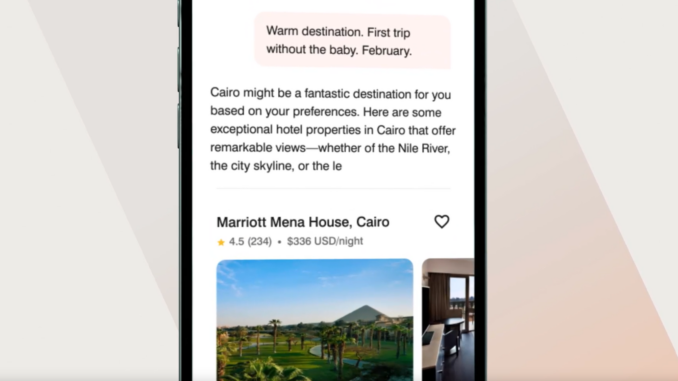
Marriott International this week entered the rapidly evolving market for AI-powered travel discovery with the launch of Ask Bonvoy™, a conversational search experience designed to help travelers explore the company’s global portfolio using natural language rather than traditional hotel search filters.
The beta launch marks one of the most significant guest-facing AI initiatives yet from a major hotel company and reflects a broader shift taking place across the hospitality industry. While much of the industry’s early AI investment focused on operational efficiency, revenue optimization and customer service automation, hotel brands are increasingly turning their attention to the top of the booking funnel, where travelers begin researching destinations, comparing experiences and deciding where to stay.
Available initially to a subset of Marriott Bonvoy members and travelers who enroll in the loyalty program, Ask Bonvoy allows users to search for accommodations by describing the type of trip they want to take rather than specifying a destination. A traveler looking for a golf-focused getaway, a luxury spa retreat, a beachfront resort with exceptional dining, or a family-friendly vacation can enter those preferences conversationally and receive recommendations from Marriott’s portfolio of approximately 10,000 properties spanning 146 countries and territories.
The move comes as conversational AI increasingly reshapes consumer expectations around search. Travelers are becoming accustomed to interacting with platforms such as ChatGPT, Google’s AI-powered search experiences and other generative AI tools that allow users to describe what they want rather than navigate complex menus and filters. As those behaviors become more common, travel suppliers are under growing pressure to modernize how consumers discover destinations and accommodations.

Marriott’s approach differs from many consumer AI applications because Ask Bonvoy is grounded exclusively in Marriott-owned and verified property information. According to the company, the platform relies on proprietary AI architecture and uses validated hotel content rather than information sourced from the broader internet. Recommendations are generated using details about amenities, dining venues, spas, recreational offerings and other property attributes maintained within Marriott’s own systems.
That emphasis on trusted data reflects a growing priority among enterprises deploying generative AI. While large language models have dramatically improved the user experience associated with search and discovery, concerns about inaccurate or outdated information remain. In hospitality, where misinformation about room types, amenities, dining options or resort features can directly impact guest satisfaction, verified content has become a critical differentiator.
The launch also underscores the strategic importance of loyalty programs in the emerging AI landscape. Marriott Bonvoy now encompasses nearly 283 million members worldwide, giving Marriott one of the largest loyalty ecosystems in hospitality. The company has already indicated that future iterations of Ask Bonvoy will incorporate loyalty points-based searches, creating opportunities for more personalized recommendations tied to guest preferences, redemption habits and travel history.
That capability could ultimately separate hotel-owned AI experiences from those offered by third-party travel platforms. While online travel agencies and search providers can aggregate information across brands, hotel companies possess a level of customer relationship data that is difficult for intermediaries to replicate. As AI becomes increasingly personalized, those proprietary datasets may become one of the industry’s most valuable competitive assets.
Marriott is far from alone in pursuing that opportunity. Earlier this year, Hilton introduced an AI-powered trip planning experience designed to help travelers explore destinations and properties through conversational interactions. The initiative reflects Hilton’s broader effort to integrate AI throughout the guest journey while strengthening direct engagement with loyalty members.
Meanwhile, Accor has been experimenting with generative AI-powered booking experiences and customer engagement tools, while other major hotel companies have invested heavily in preparing property content and digital assets for emerging AI-driven discovery platforms. Across the industry, brands are increasingly recognizing that visibility within conversational search environments may become as important as visibility within traditional search engines.
Competitive pressure is also coming from outside the hotel sector. Expedia Group has expanded its portfolio of AI-powered planning and recommendation tools, while Booking Holdings continues to invest in conversational travel planning experiences across its brands. At the same time, technology companies including Google and OpenAI are rapidly increasing their presence in travel discovery, creating new pathways through which consumers can research and evaluate accommodations.
For hotel brands, that trend creates both opportunity and risk. The hospitality industry has spent years trying to reduce dependence on third-party distribution channels by encouraging direct bookings through loyalty programs, mobile apps and member-exclusive benefits. The rise of conversational AI introduces a new layer between consumers and brands, making it increasingly important for hotel companies to establish compelling AI experiences within their own digital ecosystems.
Marriott appears to view Ask Bonvoy as a key component of that strategy. The company has steadily expanded its AI footprint over the past several years, including introducing natural-language search capabilities on the Homes & Villas by Marriott Bonvoy platform and establishing partnerships with both Google and OpenAI. Ask Bonvoy represents the most visible expression of those efforts to date and places Marriott among the most aggressive hospitality brands in applying conversational AI to guest acquisition and travel planning.
Perhaps most importantly, the platform addresses a challenge that has long existed in hotel commerce. Traditional booking engines excel at helping travelers who already know where they want to stay. They are far less effective for travelers who know only the type of experience they want. By shifting the starting point from destination selection to travel intent, Marriott is attempting to capture travelers earlier in the decision-making process, before they begin comparing rates, brands or booking channels.
Whether consumers ultimately gravitate toward hotel-specific AI assistants or broader travel planning platforms remains an open question. What is becoming increasingly clear, however, is that conversational search is quickly evolving from an experimental technology into a mainstream discovery channel. As that transition accelerates, the companies best positioned to compete may be those with the strongest combination of trusted content, loyalty relationships and direct customer engagement.
With Ask Bonvoy, Marriott is betting that those advantages will matter as much in the era of conversational AI as they have in the era of traditional hotel booking.