
By Lea Mira and Dustin Stone, HTN staff writers - 6.30.2026
A series of recent hotel technology announcements is showing how quickly artificial intelligence is moving from standalone applications into the core operating systems hotels use every day. The latest wave of product launches and company moves points to a market in which vendors are less focused on isolated tools and more focused on intelligence layers that connect the property management system, guest communications, network infrastructure, revenue management, procurement, access control, building operations and commercial sales workflows.
Many of the announcements surfaced around HITEC 2026, which took place earlier this month and where AI was not presented simply as a new product category. Instead, it appeared across core hotel workflows, embedded into platforms that already support front desk operations, guest engagement, pricing, connectivity, sales and back-office management. For hotel operators, the shift suggests that AI is becoming less of an experiment and more of an operating capability built into the systems that run the property.
One of the clearest examples came from Eleven, which acquired Stella Networks to bring automated network compliance capabilities to hospitality. The deal combines Eleven’s guest connectivity platform with Stella’s network orchestration technology, giving hotel brands and owners greater visibility from the guest Wi-Fi session to the underlying infrastructure that supports it.
The acquisition reflects the growing importance of hotel connectivity as a strategic operating layer rather than a basic guest amenity. As hotels add more connected devices, mobile check-in tools, digital keys, streaming services, cloud platforms and guest-facing applications, the network has become central to both guest experience and operational reliability.
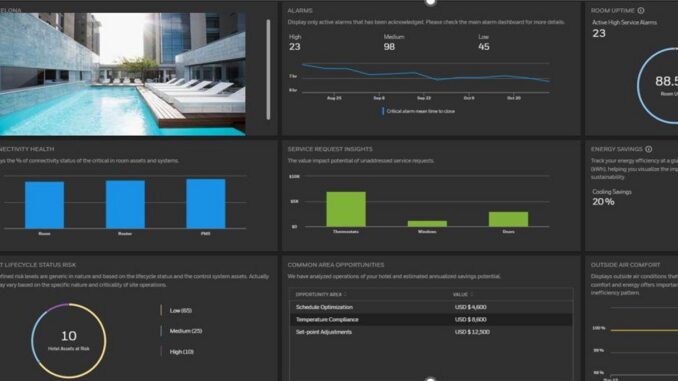
That infrastructure theme also appeared in Honeywell’s launch of new connected hospitality solutions, which are designed to unify hotel operations, access control and guestrooms through cloud-based technologies. The portfolio centers on centralized control, stronger security, smarter guestrooms, energy efficiency and real-time operational visibility.
For hotel owners and operators, the Honeywell announcement shows how building systems are becoming more tightly connected to the broader hotel technology stack. Guestroom controls, access systems, safety, security, HVAC and energy management have historically been managed separately from many guest-facing digital platforms, but the connected hotel model depends on those systems working together more intelligently.
At the core hotel operations layer, Oracle Hospitality announced Oracle OPERA Cloud Assistant, a new set of AI-powered capabilities embedded directly into OPERA Cloud workflows. The features are designed to support AI-assisted room assignments, AI-generated rate descriptions, operational guidance, translation and more consistent execution across properties.
Because the PMS remains one of the most important systems in hotel operations, Oracle’s move matters. When AI becomes embedded in the system of record used by front desk teams, revenue managers and property leaders, it has the potential to shape everyday decisions rather than automate only a narrow task at the edge of the operation.
Guest engagement platforms are moving in a similar direction. Revinate introduced Ivy, an AI decision-intelligence layer built across its platform and designed to understand a hotel’s guests, property and brand voice. Ivy is positioned to help hotels act on guest data more effectively, support direct revenue growth and automate more of the communication and decision-making that surrounds the guest journey.
Revinate also used HITEC to highlight Ivy-powered capabilities for the reservations call floor and guest inbox, including automated call scoring and Revinate Chat. The additions show how guest data platforms are moving from segmentation and campaign execution toward AI-supported decisioning across reservations, marketing, messaging, coaching and service recovery.
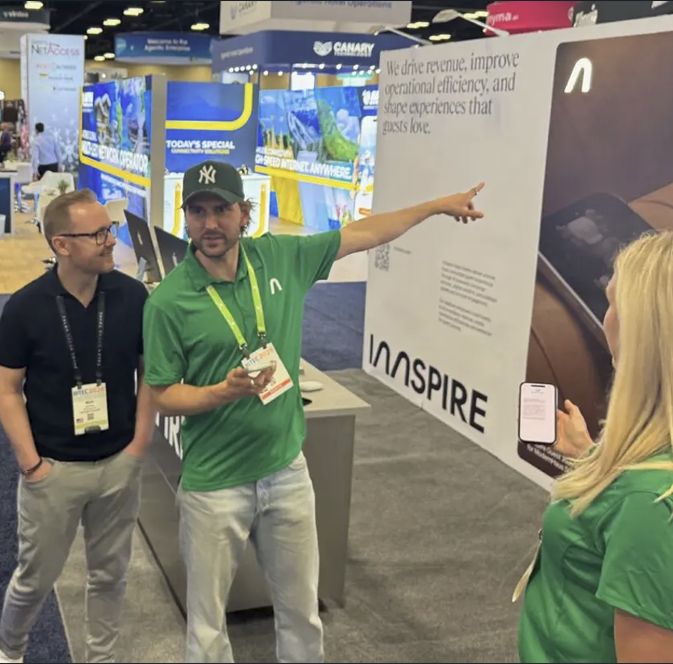
That movement toward connected guest journeys is also visible in Innspire’s launch of Guest Flows, a zero-download guest journey solution designed to deliver personalized engagement from pre-arrival through checkout. The platform supports mobile check-in, digital key, AI concierge, food and beverage ordering, upgrades, ancillary revenue and automated checkout through a guest’s smartphone without requiring an app download.
Innspire’s launch reflects the effort to make more of the guest journey digital, branded and operationally connected. Rather than treating mobile check-in, guest messaging, digital key and upselling as separate functions, platforms such as Guest Flows are trying to bring those interactions into a more unified stay experience.
The same movement toward AI-enabled direct booking is visible in the debut of Grevon, which launched at HITEC 2026 with Grevon Kore, an MCP-based connectivity layer for hospitality. The platform powers Pulse, an AI booking agent for hotel websites; Echo, an AI voice agent for inbound calls; and Ops, a staff intelligence platform.
Grevon’s launch points to an emerging competitive front in hotel distribution: making official hotel content, rates, availability and booking paths usable by AI agents. As travelers rely more heavily on conversational search and AI assistants to plan trips, hotels may need new connectivity strategies that allow their direct channels to compete more effectively against intermediaries and third-party discovery platforms.
Hotel sales and group business workflows are also becoming part of the embedded intelligence conversation. Thynk introduced a Lead Qualification Index designed to help hotels evaluate and prioritize incoming inquiries across Intent, Fit, Impact and Relationship. The tool automates RFP capture and prioritization so sales teams can identify higher-value opportunities and respond faster.
The Thynk announcement adds a commercial layer to the broader shift. Group sales, events and RFP workflows remain highly manual at many hotels, and faster qualification can affect both response times and conversion rates in a segment where speed, consistency and prioritization often determine which properties win the business.
Revenue management is also being reshaped by embedded intelligence, although the challenge in that category is not just automation but trust. RoomPriceGenie introduced Price Explanations, a feature that gives hoteliers plain-language context behind rate recommendations, including the market conditions, demand signals and property settings that influence pricing decisions.
The enhancement addresses one of the biggest barriers to broader adoption of automated revenue management tools, particularly among smaller hotels, independent properties and operators that may be cautious about handing pricing decisions to an algorithm. By making recommendations more explainable, RMS providers can help revenue teams understand not only what the system is recommending, but why.
Back-office operations are following the same pattern. Inn-Flow used HITEC to showcase expanded AI and automation capabilities across procurement, inventory, accounting, labor and business intelligence, building on its earlier acquisition of Lilo. The platform connects financial and operational workflows, including AI-assisted inventory tools and procurement capabilities that tie purchasing more closely to accounting and labor management.
For hotel management companies, that type of back-office integration can be as important as guest-facing innovation. Labor, purchasing, inventory, accounting and spend management all affect profitability, and automation can help operators reduce routine work while surfacing exceptions, anomalies and opportunities across multi-property portfolios.
Together, these announcements show hotel technology providers competing to own the workflow layer. The opportunity is no longer limited to offering a better PMS module, guest messaging tool, Wi-Fi platform, RMS, sales application or procurement platform. Vendors are trying to become the intelligence layer that interprets data, guides decisions, coordinates actions and reduces friction across the hotel operating environment.
That shift could also change how hotels evaluate technology partners. Feature lists will still matter, but operators may place more emphasis on how well a platform connects with existing systems, how clearly it explains recommendations, how much manual work it eliminates and whether it improves collaboration across departments.
The industry has seen similar transitions before. Cloud computing changed how hotels deployed and maintained software, mobile technology changed how guests interacted with properties, and integrations changed expectations around system interoperability. AI appears to be following a similar path, moving from a visible feature to an embedded capability that shapes how hotels operate behind the scenes.
For hotel operators, the takeaway is that technology is becoming more connected, more predictive and more operationally aware. The vendors best positioned for the next phase may not be those that simply attach AI to existing products, but those that use intelligence to make complex hotel operations easier to manage, easier to understand and easier to improve.