
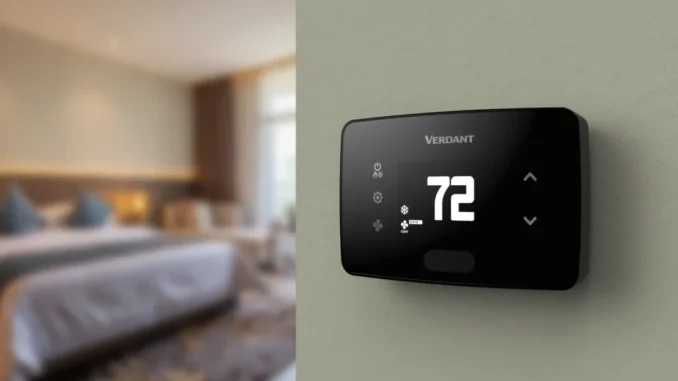
By Andrew Cao, Director of Technology and Product Portfolio at Verdant by Copeland - 7.1.2026
Artificial intelligence (AI) seems to be all anyone wants to talk about these days. It’s understandable. AI has already fundamentally changed more industries than anticipated.
The hospitality industry is already seeing the benefits of integrating AI into its business. From the basics like an AI chatbot to hotels flirting with agentic AI for booking, room assignments, and even issue resolution, artificial intelligence can help hoteliers increase operational agility, allowing staff to focus on higher-value tasks.
Can AI-powered smart thermostats deliver similar successes for hotels? Let’s look at smart thermostats in a hotel ecosystem and the possibilities for AI.
What Smart Thermostats Can Already Do Without AI
Smart thermostat technology has matured significantly over the last 15 years. Listening to industry feedback, makers of this tech have changed and improved it to enable a comfortable guest experience, easy front desk integration, and simplified management—in addition to significant energy savings.
Smart thermostats can already deliver some great value, including:
- Reduce HVAC energy waste by automatically adjusting room temperatures based on occupancy sensors and reservation data
- Integrate with hotel systems to promote operational efficiency and automation, such as automatically adjusting set back temperatures at check-out and enabling centralized monitoring and adjustments across the entire hotel portfolio
- Grid optimization through demand response participation, enabling hotels to shift load without sacrificing guest comfort
Smart thermostats are already saving hotels significant energy costs. And with the right thermostat manager software in place, front desk staff have increased control to override temperature preset programs for specific areas within a hotel or even a single room if a guest complains. The Hyatt Place San Jose is just one smart thermostat success story, having achieved a 48% average reduction in HVAC runtime and almost $10,000 in average monthly savings just by installing smart thermostats.
AI’s Impact on Smart Thermostats
AI is transforming smart thermostats from simple, schedule-based devices into systems that understand how each space is actually being used, making HVAC integration more intuitive.
Occupants of an AI-powered smart thermostat-controlled space can enjoy finer-tuned comfort. Pre-AI smart thermostat models mostly followed user-set schedules or general patterns across the space. AI helps the system learn how each room is occupied, how quickly it heats or cools, and the preferences of individual occupants. This AI learning allows the thermostat to automatically fine-tune comfort settings for each room and person, delivering comfort in a more personalized and intuitive way.
Hoteliers can enjoy an even more seamless integration with HVAC systems. Traditional connections between thermostats and HVAC systems would require a technician and great care. Newer generations of smart thermostats lowered this barrier to installation, and AI can simplify that process by understanding user intent and even interpreting tone or phrasing, then translating those requests into the right HVAC actions. Users can simply describe what they want, and the system will adjust itself accordingly.
Additional benefits of AI-enabled smart thermostats for hotel owners include:
- Better demand-response
- More streamlined maintenance
Demand Response. Hotels rarely have more than 50% occupancy, making them excellent candidates for these energy-saving programs. Enrolling with utility providers, hotels receive discounts or rebates by voluntarily reducing power use during times of high demand to avoid blackouts.
AI-powered smart thermostats would make participation even more powerful with less friction: by learning and personalizing on such an individualized level, AI can help smart thermostats participate in demand response automatically and more accurately with minimal or no disruption to guest comfort (which means happier guests and a better result for hoteliers).
Streamlined Maintenance. AI-enabled smart thermostats create new ways for contractors to work more efficiently and deliver better service. With AI-driven diagnostics, technicians can arrive better prepared, resolve issues faster, and reduce the need for return visits. Contractors can also offer preventive maintenance based on AI anomaly tracking, identifying potential problems early and optimizing performance proactively, rather than reactively.
AI Expands Smart Thermostat Capabilities
Even without AI, smart thermostats represent a transformative leap beyond conventional thermostats, giving hotels far greater control over their energy use and enabling substantial cost savings. By automating temperature management, responding to occupancy, and integrating with hotel systems, smart thermostats already unlock efficiencies that traditional systems simply can’t match.
AI builds on this strong foundation—not by replacing the benefits of smart thermostats, but by amplifying them. Where a smart thermostat follows rules, AI learns from patterns. It can identify trends in guest behavior, weather, equipment performance, and building dynamics to make more precise, adaptive decisions. Instead of relying on fixed assumptions, AI-driven models continuously update to keep improving energy efficiency. And by spotting irregularities faster, AI helps hotels maintain smooth HVAC performance and reduce maintenance costs.
Together, smart thermostats and AI open the door to deeply personalized, responsive environmental controls. Hotels can offer guests a more comfortable, tailored experience while reducing waste and improving operational efficiency. The result is a smarter, more intuitive building ecosystem where both hotels and their guests benefit from technology that anticipates needs rather than simply reacting to them.
 Andrew Cao is Director of Technology and Product Portfolio at Verdant by Copeland, the North American leader in commercial smart thermostat technology. Andrew has extensive knowledge and experience in energy management for the hospitality and multi-family markets. Throughout his career, he has designed multiple generations of the technology behind the Verdant solution. From creating new generations of the radio protocol, to building out the software infrastructure to support the scaling business, Andrew led the business with technical vision and product direction.
Are you an industry thought leader with a point of view on hotel technology that you would like to share with our readers? If so, we invite you to review our editorial guidelines and submit your article for publishing consideration.