
By Gavriel Shohet and Lea Mira, HTN staff writers - 6.19.2026
One of the more interesting questions facing foodservice operators today is whether every food program actually requires a traditional kitchen. Hotels want to offer quality meals around the clock without staffing a full back-of-house operation. Residential communities are looking for foodservice amenities without adding restaurant infrastructure. Workplace dining programs, micro-markets, convenience stores and other nontraditional venues increasingly want hot food options but often lack the space, labor or economics necessary to support conventional kitchen operations.
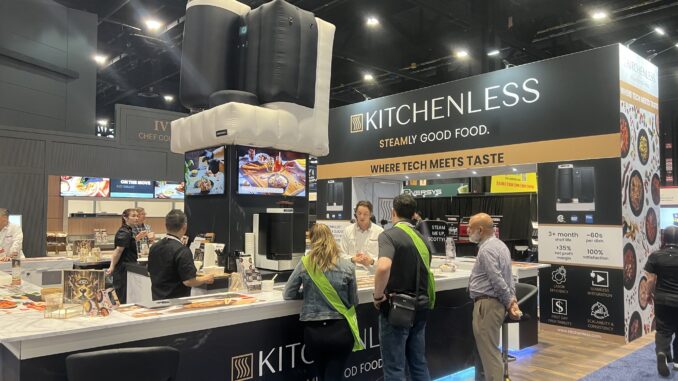
That challenge is precisely where Kitchenless is focused. The company, which exhibited at the 2026 National Restaurant Association Show, has developed a compact steam-powered platform designed to deliver chef-crafted hot meals in approximately 60 seconds without requiring a traditional commercial kitchen. For operators seeking new ways to provide foodservice in space-constrained or labor-constrained environments, Kitchenless offers a distinctly different approach to meal preparation.
Unlike many foodservice technology companies that focus on improving existing kitchen operations, Kitchenless is addressing situations where a kitchen may not exist at all. The company’s platform combines specialized equipment, chef-developed meals and a simplified operating model intended to help operators introduce foodservice programs in locations that historically would have struggled to support them.
At the center of the system is the Qeamer, a Swiss-engineered cooking device that uses patented steam technology to prepare meals quickly while preserving texture, flavor and nutritional quality. The process is designed to be highly automated. Operators place a prepared meal bowl into the unit, which scans a QR code embedded on the packaging. That code contains the dish-specific cooking instructions, allowing the system to automatically execute the appropriate preparation sequence. Using high-pressure steam and proprietary mixing patterns, the Qeamer finishes the meal in approximately one minute.
The result is a hot meal prepared with minimal labor and little operational complexity. While the technology itself is noteworthy, the broader significance lies in what it enables. By dramatically reducing the infrastructure required for meal service, Kitchenless gives operators the ability to offer food in locations where a traditional kitchen may be impractical, cost-prohibitive or operationally difficult to maintain.
The company’s target markets reflect that reality. Kitchenless is currently focused on lodging and hospitality, retail foodservice, non-commercial foodservice and chain restaurant environments. Hotels are among the most obvious applications. Many properties struggle to justify the labor and expense associated with overnight foodservice, room service or full-service dining. Yet guests increasingly expect quality food options regardless of arrival time.
Kitchenless provides an alternative model. Instead of operating a staffed kitchen around the clock, hotels can offer a menu of chef-crafted meals prepared on demand through a compact automated platform. The concept is equally relevant to lobby markets, extended-stay properties, boutique hotels and other hospitality environments where traditional food-and-beverage operations may be difficult to support profitably.
The company’s visibility within hospitality has increased in recent years. In 2025, Kitchenless won the prestigious AAHOA Tech Pitch Competition, a recognition that helped introduce the platform to hotel owners and operators across the United States. The award highlighted growing industry interest in technologies that can help properties expand food offerings while controlling labor costs and operational complexity.
Beyond hospitality, Kitchenless is also targeting workplace dining, multifamily residential communities, micro-markets, convenience retail, healthcare environments and other locations where demand exists for fresh prepared meals but staffing and infrastructure limitations create barriers. These segments have become increasingly important as operators look for new revenue streams and value-added services without committing to full-scale foodservice operations.
The company’s food strategy is an important part of the platform. Rather than simply providing equipment and asking operators to develop their own recipes, Kitchenless offers a curated menu of chef-crafted meals designed specifically for the Qeamer preparation process. The menu emphasizes global cuisine, clean-label ingredients where possible and all-day dining options spanning breakfast, lunch, dinner and dessert.
This integrated approach mirrors broader trends occurring throughout foodservice technology. Increasingly, successful platforms combine hardware, software, consumables and operational workflows into a single ecosystem. By controlling both the preparation technology and the meal design process, Kitchenless aims to create a more predictable and consistent guest experience.
Food quality is central to the company’s positioning. Automated foodservice solutions often face skepticism because consumers associate speed and convenience with lower-quality meals. Kitchenless attempts to address that concern by emphasizing steam-based preparation rather than microwave reheating. Steam cooking has long been valued in professional kitchens for its ability to preserve moisture, texture and flavor, making it a logical foundation for an automated meal platform.
The labor implications are equally significant. Labor shortages continue to challenge virtually every segment of foodservice. Recruiting, training and retaining culinary employees remains difficult, particularly for operators that need only limited foodservice capabilities. Kitchenless reduces the skill requirements associated with meal preparation, allowing organizations to offer hot food without maintaining a dedicated kitchen staff.
For operators, the business case centers on expanding foodservice capabilities while reducing complexity. A residential community can offer residents hot meals without building a restaurant. A workplace can provide employees with food options beyond packaged snacks and vending machines. A hotel can improve guest satisfaction by extending food availability beyond traditional restaurant hours. In each case, the platform creates new possibilities without requiring a conventional foodservice operation.
The technology also aligns with broader trends in foodservice automation. Much of the industry’s recent innovation has focused on labor reduction, consistency and operational efficiency. Kitchenless approaches those objectives from a different direction than robotic cooking systems or AI-assisted kitchen platforms. Rather than automating individual kitchen tasks, it simplifies the entire food production model.
That distinction is important. Many restaurant technologies are designed to improve existing operations. Kitchenless is designed to create foodservice capabilities where few previously existed. As a result, its competitive landscape includes not only other automated food solutions, but also the status quo of limited foodservice availability, outsourced meal programs and underutilized hospitality opportunities.
The company remains earlier in its market development than many of the established equipment manufacturers featured in this Vendor Spotlight series. As with any emerging platform, long-term success will depend on continued customer adoption, operational reliability, menu innovation, support infrastructure and the ability to scale effectively. The opportunity is significant, but execution will ultimately determine how broadly the concept is adopted.
Even so, Kitchenless is addressing a genuine market need. Throughout hospitality, retail foodservice and nontraditional dining environments, operators are searching for ways to provide better food experiences without taking on the costs and complexities of traditional kitchen operations. The company’s steam-powered platform offers a compelling alternative for organizations seeking to bridge that gap.
For owners, operators and technology decision-makers, Kitchenless serves as a reminder that innovation in foodservice is not always about making kitchens more efficient. Sometimes the opportunity lies in rethinking whether a kitchen is required at all. By combining automated steam preparation, chef-crafted meals and a simplified operating model, Kitchenless is helping expand where and how foodservice can be delivered.