
By Lea Mira and Dustin Stone - HTN staff writers - 7.3.2026
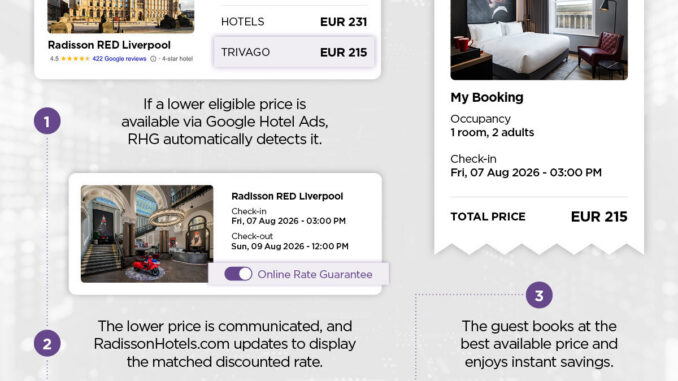
Radisson Hotel Group is replacing one of the hotel industry’s most familiar direct-booking promises with a more automated model. The company has launched an AI-powered real-time price matching feature that detects lower publicly available rates for Radisson properties on third-party booking platforms and instantly matches eligible rates on RadissonHotels.com, removing the need for guests to submit claims, screenshots or wait for manual approval.
The launch gives Radisson a new way to address a long-running challenge in hotel distribution: convincing travelers that the brand website is not only the most reliable place to book, but also the best-priced. Traditional best-rate guarantee programs put the burden on the guest to find a lower price, document the discrepancy and wait for the hotel company to verify the claim. Radisson’s model changes that process from reactive to automatic, turning price matching into part of the booking flow rather than a post-booking customer service procedure.
The feature is live across Radisson Hotel Group properties worldwide and currently checks rates from major online travel agencies and travel platforms including Booking.com, Expedia, Hotels.com, Agoda, Priceline, Trip.com, MakeMyTrip and others. When the system detects a lower eligible publicly available rate on an OTA or metasearch platform such as Google Hotels, it verifies the discrepancy and redirects the user to the hotel website with the matched rate applied.
For travelers, the appeal is clear: book direct without wondering whether a cheaper public rate is sitting elsewhere online. For hotels, the benefits are both operational and commercial. Automating the process removes the administrative burden of manual best-rate claims while giving Radisson better visibility into pricing discrepancies, customer behavior and the moments when guests may be at risk of leaving the direct channel.
The move reflects how hotel companies are using AI to remove friction from established commercial workflows. Price parity, direct booking conversion and OTA dependency have been strategic concerns for years, but many solutions still require revenue managers, distribution teams or customer service teams to react after a discrepancy appears. Radisson’s approach brings that intelligence closer to the transaction itself.
Most major hotel groups continue to promote best-rate or price-match guarantees, but the processes still generally depend on manual claim submission and review. Marriott requires guests to find a qualifying comparison rate and submit a Best Rate Guarantee claim within 24 hours of booking. Hilton asks guests to submit a claim before booking or within 24 hours after booking. Hyatt uses an online claim process that is reviewed after submission, while IHG Hotels & Resorts requires guests to complete an online claim form to receive its Best Price Guarantee benefit.
Those programs remain useful as marketing promises, but they were designed for an earlier stage of online booking behavior. Travelers now compare rates across brand sites, OTAs, metasearch engines, loyalty programs and mobile apps in seconds. A guarantee that requires a form, a screenshot and a waiting period may reassure some guests, but it does little to keep a traveler from leaving the brand website while shopping.
Radisson’s launch also places the company in a technology category that has been gaining momentum among hospitality solution providers. Triptease offers automated Price Match capabilities that can match OTA rates on hotel booking engines and metasearch, while allowing hotels to choose which OTAs to match and how much discounting control they want to maintain. The company positions the product around protecting direct bookings from OTA undercutting while applying only the minimum discount needed to win the booking.
Other direct-booking and revenue technology providers are attacking the same problem from adjacent angles. 123Compare.me offers real-time OTA checks and automatic direct-rate adjustments when third-party prices undercut the hotel’s website, including support for Google Hotel Ads traffic. Lighthouse, meanwhile, has expanded its rate parity strategy through a partnership with Bowerbird Technologies that combines AI-powered parity monitoring with enforcement against unauthorized inventory and repeat offenders.
What makes Radisson’s announcement noteworthy is not that automated price matching itself is new, but that a global hotel group is embedding the capability directly into its brand.com booking strategy across its portfolio. The feature positions automated parity response as a guest-facing direct-booking capability, not only a revenue management or distribution control tool.
Rate disparity is rarely just a pricing problem. It can be caused by wholesale inventory leakage, loyalty or member-only pricing on third-party channels, taxes and fees displayed differently across platforms, currency conversion issues, mobile-only discounts, package rates, or mismatched room and cancellation conditions. By the time a guest sees a cheaper rate elsewhere, the hotel has already lost some control over the booking journey.
Real-time price matching does not solve every one of those issues at the source. Hotels still need strong distribution controls, contract enforcement, parity monitoring, channel management discipline and clean connectivity across CRS, booking engine, metasearch and OTA partners. But it does give the brand website a better chance to recover demand when price-sensitive shoppers might otherwise defect.
There are also commercial trade-offs. Matching a lower OTA rate can protect a direct booking and preserve the customer relationship, but it can also reduce room revenue if the hotel simply follows the lowest visible price in the market. The business case depends on whether the matched direct booking produces better net revenue than the third-party booking after commissions, loyalty value, customer data, upsell opportunities and future direct engagement are considered.
For many hotel companies, that calculation increasingly favors direct channels. A booking through the brand website gives the hotel more control over guest data, pre-arrival communication, loyalty enrollment, ancillary offers and service recovery. It also reduces the risk that the guest’s relationship remains primarily with the intermediary rather than the hotel brand.
Radisson’s feature raises the bar for transparency in direct booking. The industry has spent years telling guests that direct is best, but travelers have learned to verify that claim for themselves. An automated price match changes the tone of the promise by moving from “trust us” to a more immediate assurance that eligible lower public rates can be detected and matched in real time.
Large hotel brands may face pressure to modernize their own best-rate guarantees, particularly if travelers begin to see manual claim processes as outdated. Independent hotels and smaller groups may turn to vendors such as Triptease, 123Compare.me, Lighthouse, The Hotels Network, RateGain or other direct-booking and parity platforms to deliver similar capabilities without building them internally.
The OTA side of the market is unlikely to stand still. Third-party platforms compete aggressively on price visibility, loyalty discounts, packaged rates, mobile offers and metasearch placement. If more hotel brands move toward automatic matching, OTAs may respond with more differentiated member pricing, bundled offers or value-added merchandising that makes direct price comparison harder.
For hotel technology vendors, Radisson’s launch reinforces a broader market direction: distribution technology is moving from monitoring and reporting toward automated action. Rate shopping, parity alerts and best-rate guarantees have long helped hotels understand where they are being undercut. The next phase is about applying that intelligence inside the booking path quickly enough to change the outcome.
For hotel operators, price matching is only part of the story. Direct booking tools are becoming more dynamic, more automated and more connected to real-time market conditions. As AI becomes embedded in booking engines, metasearch, revenue management and guest engagement platforms, the advantage will shift toward hotels that can identify friction in the booking journey and respond before the guest leaves.
Radisson’s price matching technology is a clear example of that shift. It does not eliminate the need for disciplined distribution management or stronger OTA relationships, but it gives the direct channel a more credible answer when lower third-party rates appear. In a market where travelers compare prices instantly and loyalty is often tested at the point of purchase, that may become an increasingly important part of the hotel brand’s digital strategy.