
By Lea Mira, HTN staff writer - 3.12.2026
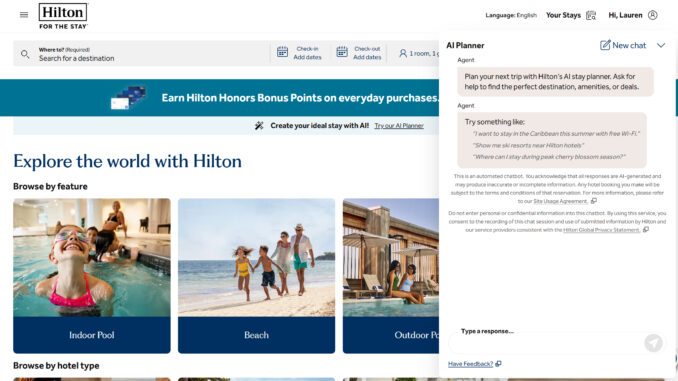
Hilton has introduced a new generative AI–powered planning tool designed to help travelers explore its global portfolio of hotels and simplify the process of planning and booking a stay. Announced this week, the new Hilton AI Planner is currently in beta testing on Hilton.com and is being rolled out initially to a limited portion of site traffic as the company evaluates how guests interact with the technology.
The Hilton AI Planner functions as a digital concierge that uses conversational intelligence to guide travelers through the hotel discovery and booking process. Instead of relying solely on traditional search filters, users can describe their travel preferences and receive real-time recommendations about destinations, properties and amenities across Hilton’s portfolio of more than 8,000 hotels worldwide.
The tool is designed to assist travelers at multiple stages of the shopping journey. Guests can use the AI Planner to identify destinations, compare hotel options, explore property amenities and refine travel plans through a conversational interface that responds dynamically to user questions. Hilton says the platform delivers curated recommendations and real-time responses intended to make travel planning faster and more intuitive.
The new AI capability reflects a broader shift underway across the hospitality industry as hotel brands race to incorporate generative AI into the digital guest experience. Over the past two years, travelers have increasingly turned to conversational AI tools to research destinations and plan trips. By embedding similar capabilities directly into its own booking platform, Hilton aims to keep travelers within its digital ecosystem while improving the overall planning experience.
“For decades, Hilton has been at the forefront of hospitality innovation – from the award-winning Hilton Honors app to the most widely available Digital Key and the industry-first Confirmed Connecting Room,” said Michael Leidinger, senior vice president and chief information officer at Hilton in a press statement. “The launch of the Hilton AI Planner marks another step forward in our journey to reimagine the travel experience for Hilton guests. This is just the beginning and a preview of where we’re going, as we continue to focus on providing thoughtful, purposeful innovation that empowers travelers.”
The introduction of the Hilton AI Planner builds on a long track record of technology initiatives that have helped position Hilton as one of the more digitally advanced brands in hospitality. The Hilton Honors mobile app has become a central component of the company’s loyalty and digital engagement strategy, while technologies such as Digital Key and Connected Room have helped redefine how guests interact with hotel rooms and services.

Digital Key allows guests to bypass the front desk and unlock their rooms using a smartphone, while Connected Room technology enables guests to personalize lighting, temperature and entertainment settings through digital controls. Hilton also introduced Confirmed Connecting Room, a booking feature that allows families and groups to guarantee adjoining rooms at the time of reservation.
The AI Planner represents the next step in Hilton’s effort to extend digital innovation earlier into the travel planning process. Historically, hotel websites have relied primarily on keyword search boxes and filter tools similar to those used by online travel agencies. Generative AI introduces a more conversational approach, allowing travelers to describe their preferences in natural language rather than manually navigating through lists of filters and property pages.
Instead of simply entering a destination and scrolling through hundreds of listings, travelers can ask questions about beachfront resorts, family-friendly hotels or properties located near specific attractions. The system then interprets the request and surfaces relevant hotel options along with contextual information about amenities and travel considerations.
Hilton’s decision to release the AI Planner initially to a limited audience reflects a deliberate test-and-learn strategy that has become common among large travel companies deploying generative AI technologies. By monitoring how guests use the tool and collecting feedback during the beta phase, Hilton can refine the system’s recommendations and conversational responses before expanding access to a broader user base.
The competitive landscape around AI-powered travel planning is evolving rapidly. Online travel agencies such as Expedia and Booking.com have begun integrating conversational AI assistants into their platforms to help travelers research destinations and build itineraries. These tools aim to simplify trip discovery while encouraging users to remain within the platform’s ecosystem.
Hotel companies face a different set of incentives. Direct bookings remain a strategic priority for most major brands because they reduce reliance on third-party distribution channels and help preserve direct relationships with guests. Embedding AI-driven planning capabilities into brand websites and apps allows hotel companies to influence the discovery process while improving the overall booking experience.
Hilton’s move also comes as other major hotel groups expand their digital platforms. Marriott International has invested heavily in the Bonvoy mobile ecosystem, while Accor and IHG Hotels & Resorts have introduced digital concierge and guest messaging platforms designed to personalize the in-stay experience. Generative AI, however, is pushing innovation further upstream into the planning and shopping stages of the guest journey.
Industry observers increasingly view the discovery phase as a key battleground in hospitality technology. The company that helps travelers identify where they want to stay often gains an advantage in converting that interest into a booking. AI planning tools therefore have the potential to become a strategic component of hotel companies’ digital platforms.
Another dimension of the competitive landscape involves technology providers that supply AI infrastructure to the travel industry. Cloud platforms such as Microsoft Azure, Google Cloud and Amazon Web Services are rapidly expanding their generative AI capabilities, enabling hospitality companies to build conversational interfaces and recommendation systems on top of their data platforms.
Hilton has not disclosed detailed technical specifications for the AI Planner, but the system relies on generative AI models capable of interpreting natural language queries and synthesizing information from Hilton’s global property database. Accurate data about hotel amenities, availability and location attributes plays a critical role in ensuring that AI recommendations remain useful and relevant.
Personalization is expected to be one of the most significant long-term advantages of AI-driven planning tools. As the system learns from user behavior, booking history and loyalty program data, it may eventually tailor recommendations more precisely to individual travelers. Business travelers, for example, might receive suggestions emphasizing proximity to convention centers or transportation hubs, while leisure travelers could be shown properties with resort amenities or family-oriented features.
Hilton says insights gathered during the beta phase will inform the evolution of the AI Planner. Feedback from real user interactions will help the company refine how the system interprets queries, structures recommendations and surfaces relevant information.
Over time, generative AI tools could extend beyond hotel discovery into other aspects of the travel experience. AI planners may eventually assist with itinerary building, recommend on-property experiences or coordinate multiple elements of a trip such as flights, ground transportation and activities.
Despite the excitement surrounding generative AI, hospitality companies are approaching deployment cautiously. Ensuring accuracy, protecting guest data and maintaining brand voice are important considerations when introducing AI-driven interactions. Hilton’s incremental rollout reflects a broader industry effort to balance innovation with reliability and guest trust.
The debut of the Hilton AI Planner arrives at a moment when travelers increasingly expect digital tools that deliver speed, simplicity and personalized recommendations. For Hilton, the initiative represents both a response to changing consumer behavior and a continuation of its long-standing focus on technology-enabled guest experiences.
As the AI Planner evolves, Hilton says it will continue using a test-and-learn approach, incorporating feedback and behavioral insights to improve how the system anticipates guest needs and streamlines the booking process.
If successful, tools like the Hilton AI Planner could fundamentally reshape how travelers discover and book hotel stays. What begins as a conversational assistant helping guests explore destinations may ultimately become a central interface through which travelers interact with hospitality brands throughout the entire journey.