
By Graham Rushin, Deputy CEO at IRIS - 6.10.2026
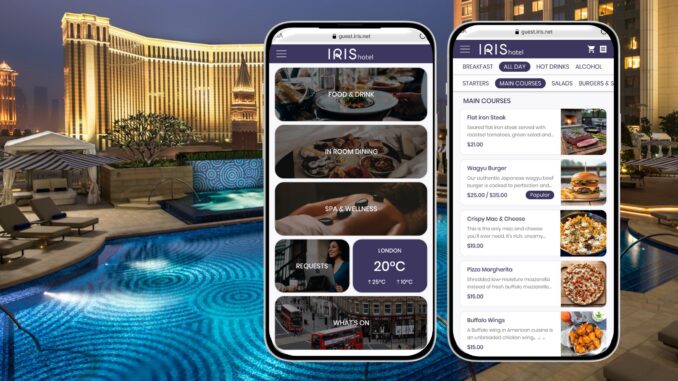
The appetite for mobile ordering across F&B, concierge and guest directory services is stronger than ever. As digitally native generations mature, demand shows no sign of easing, with guests expecting to browse menus, book services, place orders and pay from their phone, whenever and wherever it suits them.
Operators now firmly recognize the opportunity mobile ordering offers in terms of revenue, operational efficiency and an improved experience for both staff and guests. For independent and individual properties, integrating a mobile ordering platform is relatively straightforward. However, in the case of hotel groups with multiple properties often in multiple locations and with multiple scales of operation, mobile ordering when not unified can present a number of challenges that put both guest experience and revenue at risk.
The hidden cost of fragmentation
To appreciate the benefits of a unified approach to mobile ordering platforms, it is important to firstly understand the challenges of operating without it.
When evaluating mobile ordering providers, it can be tempting to default to a POS provider’s system. Seemingly easier to integrate and more cost effective. But what might save cost in the short term as a quick fix can prove more costly in the long term.
Why? The core challenge lies in fragmentation. If properties from the same group operate across different mobile ordering platforms from their POS providers, then at a more macro, group-wide level, the result is inevitably inconsistency. This can be confusing for guests and has the potential to impact guest experience, loyalty and can indeed create distrust in the system being presented in different properties.
The operational challenge of fragmentation can be equally damaging. Disconnected, disjointed platforms mean multiple systems to manage, staff trained on different interfaces, separate integrations to troubleshoot and siloed content to maintain. This can result in additional and unnecessary time, budget and resource spent on coordinating systems rather than focusing on delivering exceptional service and enhancing the guest experience. Some of the most successful Franchise Management Companies now have a dedicated HQ resource to oversee the ancillary revenue opportunity and are driving hundreds of thousands of dollars of revenue.
How unified mobile ordering is redefining guest loyalty for hotel groups
For operators, a unified mobile ordering platform delivers a host of benefits for staff, guests and the balance sheet.
From a staff perspective, a more unified mobile ordering platform can not only integrate with the on-site POS, but also at group level, alongside the PMS and payment infrastructure. As a result, operators can manage systems and operations centrally, in real-time, to ensure menus are up-to-date and accurate without the need for time-consuming, manual updates. The result is fewer mistakes, less friction, faster service and happier guests more inclined to repeat book and repeat order.
For guests, a more consistent, unified experience results in confidence and trust. They recognize and understand how to navigate the mobile ordering menu or digital guest directory, for example, swiftly and safely. Accessing the same intuitive, brand-aligned interface at every property within a group’s portfolio reinforces both trust and loyalty.
Key questions to consider
- Is it able to integrate across the different POS systems your portfolio already runs?
- Does it deliver a consistent, branded guest interface regardless of what’s happening in the back end?
- Can it be centrally managed to update menus and content across all properties simultaneously?
- Is it scalable with the ability to accommodate new hotels, new brands and new markets without wholesale rebuilding?
- Is it feature-rich enough to drive revenue, with pre-ordering, upselling, loyalty integrations, language translation, real-time allergen management, loyalty and of course marketing opportunities already built in?
Choose a partner invested in your success that will grow with you
The hotel groups that are reaping real revenue, operational and guest experience reward from their mobile ordering partners are the ones doing their homework. They’re working with those vendors that have the capacity to not just plug and play but rather take a more comprehensive approach to property-wide efficiencies and brand-aligned access.
Hotel groups have strong ambitions for growth. Mobile ordering has swiftly established itself across the sector as a non-negotiable for both guests and operators. Therefore, laying solid mobile ordering foundations is now fundamental to ensuring they can realize these ambitions. That means ensuring working with a partner that is platform-agnostic and can fully integrate across multiple tech ecosystems to deliver a consistent, feature-rich platform that delivers for the brand, the staff, operations, the guest and profit lines. Otherwise, operators run the risk of managing a fragmented system that costs more than it delivers.
 Graham Rushin is Deputy CEO at IRIS. IRIS is one of the top Microsoft Azure partners in the UK and has enabled 1000’s properties across the globe to deliver an innovative digital guest experience, including many of the world’s top hotel chains such as Marriott, Hilton, Mandarin Oriental, IHG and Four Seasons. Graham started out his career as an electronics engineer but soon discovered he enjoyed the IT sector and helping customers navigate through the world of all things IT. He joined IRIS in 2012 having spent the best part of 20 years in the hospitality space as a vendor across PMS and POS products. Previously serving as Vice President of Sales and Marketing, Graham was promoted in June 2026 to drive IRIS’s next phase of growth, with responsibility for expanding its mobile ordering platform, accelerating international expansion in Asia and the Middle East, and strengthening partnerships with major hotel brands. He also leads efforts to enhance the digital guest journey and expand IRIS’s ecosystem of technology integration partners.
Are you an industry thought leader with a point of view on hotel technology that you would like to share with our readers? If so, we invite you to review our editorial guidelines and submit your article for publishing consideration.