
By Dustin Stone, HTN staff writer - 6.10.2026
Lighthouse has accelerated its push into AI-powered hotel distribution with the acquisition of Hotelrank.ai, a startup focused on measuring how hotels appear across generative AI platforms such as ChatGPT, Gemini and Anthropic. The move adds AI visibility analytics to Lighthouse’s Connect AI platform, creating what the company describes as a more complete solution for helping hotels understand, manage and improve their performance across emerging AI travel planning channels.
The acquisition comes as generative AI rapidly transforms how travelers discover destinations, research accommodations and evaluate booking options. While hotels have spent decades optimizing for Google search results, online travel agencies and metasearch platforms, a growing share of travel inspiration and trip planning is now occurring inside conversational AI tools, creating new challenges around visibility, attribution and direct booking conversion.
For hoteliers, the problem is that AI recommendations often function as a black box. A hotel may appear prominently in one AI-generated itinerary while being absent from another, yet operators have had little visibility into why certain properties are recommended, which sources influence those recommendations or whether AI-generated traffic is being directed to hotel websites or OTAs.
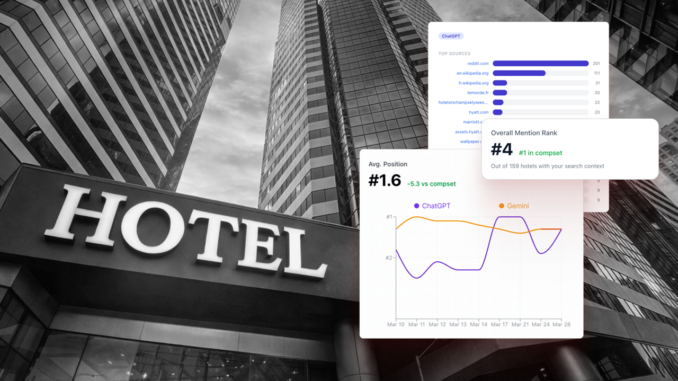
Hotelrank.ai was created specifically to address that gap. Founded in 2025 by hospitality technology veterans Nicolas Sitter and Benjamin Pipat, the company developed a platform that continuously tests how major AI models respond to travel-related hotel searches, measuring visibility, rankings, citations and competitive positioning. The company gained industry attention through its AI Hotel Landscape 2026 research project, which analyzed more than 245,000 hospitality-related sources and over 31,000 hotels to better understand how generative AI platforms build recommendations and which factors most influence visibility.
Rather than focusing solely on rankings, Hotelrank.ai examines what it calls “AI perception.” The platform measures how AI systems describe a hotel’s amenities, location, service quality, value proposition and guest experience, giving commercial teams insight into how their brands are being represented across AI-generated travel recommendations. Hotels can benchmark themselves against competitive sets, monitor performance trends and evaluate whether AI-generated booking recommendations are directing travelers to direct booking channels or third-party intermediaries.
Those capabilities fit naturally into Lighthouse’s broader commercial platform strategy. Founded in 2012 as OTA Insight, Lighthouse built its reputation helping hotels optimize pricing, revenue strategy and market intelligence before expanding into a broader commercial platform serving more than 80,000 hotels across 185 countries. Through acquisitions including Stardekk and The Hotels Network, the company has steadily added channel management, connectivity, personalization, direct-booking optimization and marketing capabilities designed to connect pricing, distribution, marketing and performance management into a single operating environment.
Connect AI represents the latest stage of that evolution. Introduced earlier this year, the platform was designed to help hotels become discoverable and bookable within AI-powered travel experiences by providing structured, verified hotel content that can be consumed by AI agents and travel planning platforms. By integrating Hotelrank.ai, Lighthouse now combines optimization and measurement capabilities, allowing hotels to monitor AI visibility scores, benchmark competitors, analyze traveler personas and evaluate whether AI-generated recommendations favor direct booking channels or OTAs.
The direct-booking component may prove particularly significant. Early AI travel research suggests that generative AI platforms often cite hotel websites directly rather than automatically routing users through online travel agencies. While outcomes vary by platform and query type, the possibility of AI becoming a meaningful direct-distribution channel has attracted significant attention from hotel brands seeking to reduce acquisition costs and strengthen ownership of the guest relationship.
That potential explains why AI visibility is quickly evolving from a marketing concern into a commercial strategy issue. For decades, hotels have measured performance across search engines, metasearch platforms, OTAs and direct channels, but AI-powered travel discovery introduces an entirely new layer of demand generation that requires its own analytics, benchmarks and optimization strategies.
The acquisition also highlights the emergence of a new competitive category within hospitality technology. Revenue management providers, digital marketing platforms, booking engine vendors and distribution companies are all exploring ways to help hotels influence how AI systems interpret and recommend their properties, while major travel platforms such as Booking.com, Expedia Group and Google Travel continue investing heavily in AI-powered planning experiences designed to keep travelers within their own ecosystems.
Lighthouse’s strategy appears centered on helping hotels maintain ownership of their visibility and direct-booking opportunities as AI increasingly becomes part of the travel planning process. As AI-powered trip planning gains traction, the ability to measure and influence AI recommendations may become as important to commercial performance as SEO, metasearch optimization and revenue management are today, creating an entirely new discipline at the intersection of distribution, marketing and commercial strategy.