
By Riccardo Grechi, Founder of The Double Strainer - 9.27.2026
Hotels rarely suffer from a shortage of beverage data. The point-of-sale system records what was sold. Inventory tools show what was purchased and counted. Recipe files calculate what should have been consumed. Scheduling platforms record labor, while waste, transfers, discounts and complimentary items may be captured somewhere else. The problem is that these records usually describe different versions of the same service.
A busy hotel bar can therefore produce a full week of reports without giving managers a reliable answer to the questions that matter: What should be ordered? Which items should be prepared? Where is margin leaking? Which outlet needs training? Which menu items deserve more visibility, and which should be removed?
The operational opportunity is not another dashboard. It is a decision system that connects sales, stock movement, recipes, exceptions and service conditions closely enough for managers to act while the information is still useful.
Start With the Decision Rather Than the Dashboard
Many reporting projects begin with a list of available data fields. A more useful starting point is the recurring decision that an operator needs to make. Beverage data should support a defined action, owner and frequency.
- Purchasing decisions: How much stock should be ordered for each outlet, event and demand period?
- Production decisions: Which batches, garnishes and syrups should be prepared, in what quantity and at what time?
- Menu decisions: Which drinks combine strong demand, contribution margin and operational feasibility?
- Staffing and training decisions: Where do slow execution, inconsistent portions or repeated errors indicate a skills gap?
- Control decisions: Which variances require investigation and which are explained by approved transfers, waste or complimentary service?
Once the decision is clear, the reporting requirement becomes smaller and more precise. A daily production plan needs recent sales patterns, reservations, events and current stock. A monthly menu review needs sales mix, contribution margin, preparation burden and recurring variance. Combining every available metric into a single screen often creates visibility without direction.
Build One Operational Version of Every Drink
Connected reporting depends on a shared unit of truth. For beverage operations, that unit is the active recipe. Each sellable item should have one current recipe, one defined yield, one POS identifier and a clear relationship to inventory units.
This sounds basic, but hotel beverage programs change constantly. A spirit is substituted while purchasing waits for a delivery. A garnish is removed during a busy weekend. A batched recipe is adjusted, but the inventory system still uses the old yield. Banqueting applies a different portion from the lobby bar. Each change creates a small difference between theoretical and actual consumption.
Version control matters more than sophisticated analytics when the underlying recipe map is unreliable. A practical system records when a recipe changes, who approved it, which outlets use it and how the revised quantities affect theoretical cost and depletion. Without that discipline, automated variance reports simply calculate discrepancies more quickly.
Connect the Five Signals That Explain Beverage Performance
No single metric explains why a beverage program is performing well or poorly. Hotel operators need five connected signals.
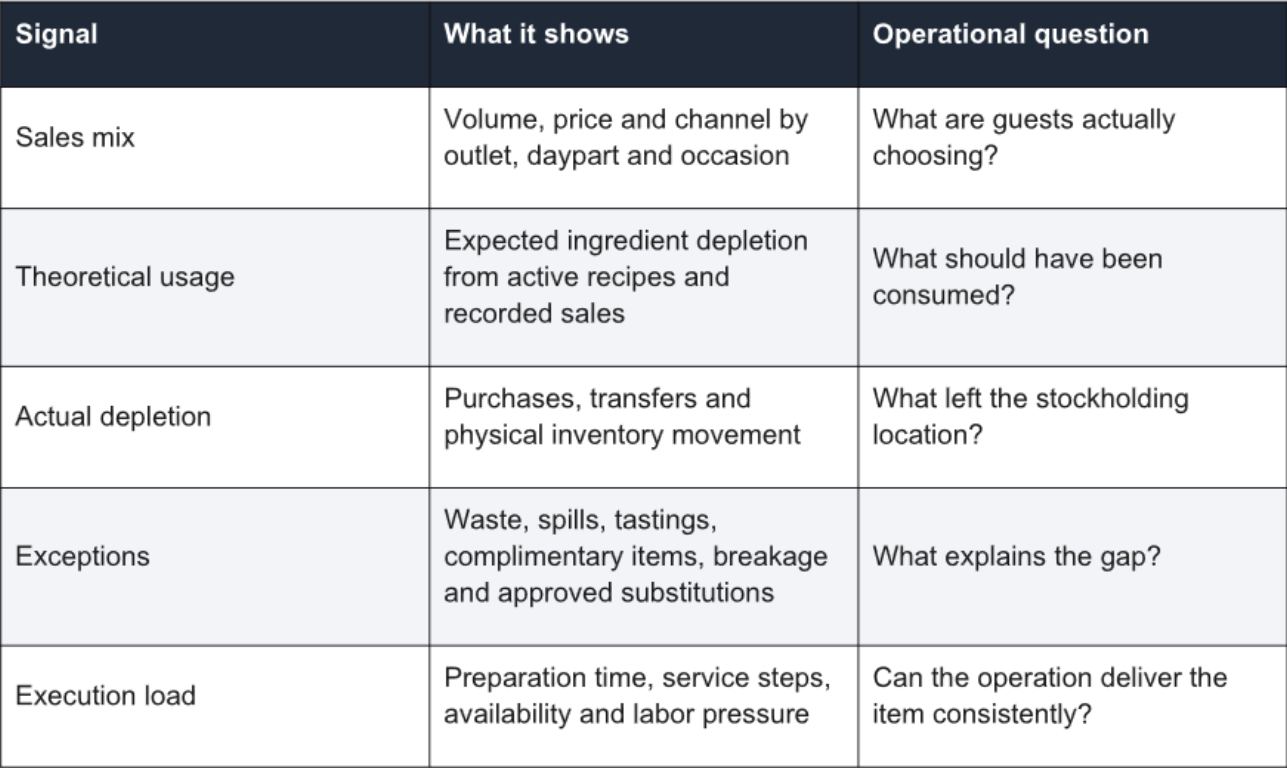
The value comes from comparison. If actual depletion exceeds theoretical usage and exceptions are not recorded, the operator has a control or data-capture problem. If usage matches but contribution margin is weak, the issue may be price, recipe cost or sales mix. If a profitable item is frequently unavailable, production planning rather than demand is limiting revenue.
Move Beyond Pour Cost
Pour cost remains useful, but it is not a complete decision rule. A low-cost cocktail that sells rarely, takes several minutes to produce and generates waste may contribute less to the business than a higher-cost drink with strong demand, fast execution and reliable availability.
A practical menu review should consider at least five dimensions: contribution margin per sale, sales velocity, preparation and service burden, ingredient variance, and availability during the periods when guests want to buy the item. Hotel context adds another layer. The same beverage may perform differently in the lobby bar, pool bar, club lounge, room service and banqueting because demand patterns, staffing and service expectations differ.
This is why outlet-level segmentation matters. Combining all beverage sales into one property total can hide the operational story. A high-volume conference week should not determine the normal purchasing pattern for an intimate cocktail bar. A pool bar’s weather sensitivity should not distort a lobby lounge forecast. The technology should preserve property-wide visibility while allowing managers to understand each outlet and occasion separately.
Capture the Exceptions at the Moment They Occur
Variance is often treated as evidence of poor control, but unexplained variance and operational variance are not the same. Tastings, guest recovery, spills, breakage, recipe trials, inter-outlet transfers and substitutions may all be legitimate. When they are recorded late, inconsistently or on paper, the system loses the reason behind the movement.
The best exception process is short enough to use during service. Staff should be able to record the item, quantity, reason, outlet, time and author without leaving the operational workflow. Managers can then distinguish between an isolated event and a repeating pattern. Ten separate “minor” waste entries linked to the same garnish or batch may reveal a production problem that a monthly stock count cannot explain.
Turn Reporting Into an Operating Rhythm
Data becomes operational when it has a cadence. Different decisions require different review intervals.
- Before service: Review reservations, occupancy, group business, outlet demand, events and stock constraints. Adjust preparation and transfers before teams become busy.
- After service: Capture shortages, waste, substitutions and unusual demand while the shift is still fresh. Resolve missing records before they become monthly mysteries.
- Weekly: Compare sales mix, theoretical usage, actual depletion, availability and high-value exceptions. Assign corrective actions to a named owner.
- Monthly: Review menu performance, supplier changes, recipe versions, persistent variance and the effect of promotions or seasonal activity.
A report without an owner is an archive. Each review should end with a decision, a responsible person and a date for checking the result. That feedback loop also improves the data itself because teams learn which inputs matter and why accurate recording affects real operational choices.
What Hotel Operators Should Require From Their Technology
Hotels do not need every system to perform every function. They do need reliable movement of information between the systems that already support the operation. When evaluating or configuring beverage technology, operators should look for practical capabilities rather than feature volume.
- Consistent identifiers and recipe mapping: The same product and sellable item should be recognizable across POS, inventory and costing records.
- Outlet and occasion segmentation: Reports should separate restaurant, bar, lounge, pool, room service, minibar and event activity without losing the property-level view.
- Time-stamped version control: Recipe and price changes should be traceable so historical results are interpreted against the correct configuration.
- Accessible exception capture: Operational teams need a fast way to record waste, transfers and substitutions at the point of activity.
- Usable exports and integrations: Managers should be able to reconcile information without rebuilding every report manually.
- Role-based visibility: Executives, finance teams and outlet managers need different levels of detail while working from the same underlying records.
A Practical Thirty Day Starting Plan
A hotel can improve beverage decisions without replacing its entire technology stack. The first month should focus on one outlet and one repeated management question.
During the first week, choose the decision to improve, such as ordering, production or menu review. In the second week, verify the active recipes, yields, POS identifiers and inventory units for the outlet’s highest-volume items. In the third week, connect sales, theoretical consumption, actual depletion and exceptions for those items. In the fourth week, run one review meeting, assign actions and document what information was missing or unreliable.
This limited pilot reveals the real integration problem before the hotel invests in a larger reporting project. It also produces a workflow that can be repeated across other outlets, rather than a dashboard that looks complete but does not change daily decisions.
The Goal Is Better Decisions While They Still Matter
Beverage data creates value only when it changes an operational choice. The objective is not perfect information at the end of the month. It is a credible signal early enough to adjust an order, modify a batch, retrain a team member, correct a recipe or reposition a menu item before the next service.
Hotels already possess much of the information needed to make those decisions. The next step is to connect it around the work beverage teams actually perform. When technology, recipes and operating routines describe the same reality, data stops being a reporting exercise and becomes part of service management.
 Riccardo Grechi is a beverage manager and consultant with more than 10 years of international experience across luxury hotels, independent venues and beverage brands in Europe and Asia. With more than 10 years of hands-on experience across Europe and Southeast Asia, his work combines cocktail R&D, menu engineering, cost control, SOP development, training, and beverage-program design. He is the founder of The Double Strainer, a beverage education and consultancy platform focused on menu engineering, costing, SOPs, staff training and operational execution.
Are you an industry thought leader with a point of view on hotel technology that you would like to share with our readers? If so, we invite you to review our editorial guidelines and submit your article for publishing consideration.