
9.18.2026
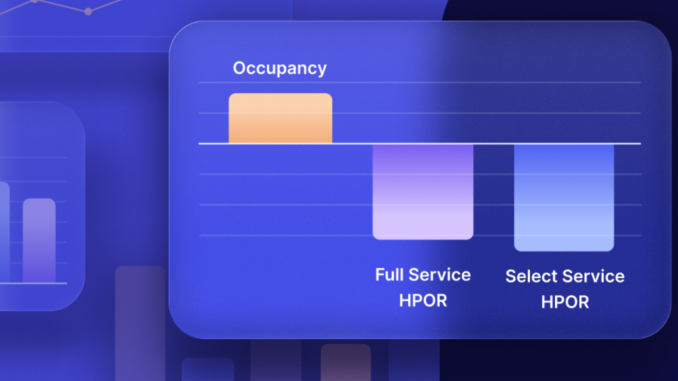
Full Service and Select Service hotels improved labor productivity during the first half of 2026 even as demand strengthened. Based on Hotel Effectiveness data from approximately 5,000 U.S. hotels, the report finds that Hours per Occupied Room (HPOR)—a key indicator of how efficiently a hotel scales labor with demand—fell year over year in every month of H1 for both hotel types.
The findings also illustrate the growing value of labor-management technology that gives operators more detailed and timely visibility into staffing performance. They help explain how hoteliers increased GOP margins by 3.6 percentage points year over year during H1, as reported in HotelData.com’s H1 Profitability Performance Report.
Key Findings
- Full Service HPOR fell 3.1% in H1 2026 year over year.
- Select Service HPOR declined 3.5%.
- HPOR was lower year over year in every month of H1 across both hotel types, although the strongest gains came in Q1 and moderated in Q2.
- Productivity improved while hotel occupancy increased 1.1 percentage points.
- Select Service Room Attendant MPOR fell 5.0%, the strongest position-level improvement.
- Hourly wages rose between 2.9% and 3.3% across tracked hotel roles.
HPOR measures the number of labor hours a hotel uses per occupied room. When HPOR falls while occupancy rises, hotels are generating operating leverage by serving more rooms without requiring a proportional increase in labor hours. That is what the H1 2026 data shows. Full Service hotels reduced HPOR from 0.810 to 0.785, a 3.1% decline year over year. Select Service hotels reduced HPOR from 0.684 to 0.660, a 3.5% decline.
For hotel operators, this type of data can make labor productivity more actionable. Rather than waiting for month-end financial reports, managers using labor-management platforms can compare scheduled and actual hours with occupancy levels and identify emerging variances by department or position.
Both hotel types posted improvement in every month from January through June, but the gains slowed in Q2. Full Service HPOR improved 3.7% year over year in Q1 and 2.5% in Q2. Select Service showed a stronger Q1 result at 5.1% before narrowing to 1.8% in Q2. That pattern reflects the increasing difficulty of sustaining gains after a strong improvement period, particularly as occupancy and workloads grow. It also underscores the importance of monitoring labor performance continuously as demand changes.
Position-level data reinforces the finding. Minutes per Occupied Room (MPOR) declined across all hourly housekeeping positions in both Full Service and Select Service hotels. Select Service Room Attendants delivered the strongest result, reducing MPOR by 5.0%, from 24.01 minutes to 22.82. That represents a savings of roughly 1.2 minutes per occupied room. Full Service Room Attendants and housepersons each improved by 2.7%. Every position analyzed used fewer minutes per occupied room than in H1 2025.
That level of detail matters because it allows hotel teams to look beyond an overall labor figure and determine where productivity is improving. Position-level benchmarks can help managers identify practices worth extending across a property or portfolio while also highlighting departments where labor use is beginning to drift from established targets.
Those gains came despite a challenging operating environment. Hourly hotel wages rose between 2.9% and 3.3% across tracked roles. Consumer prices rose 3.5% year over year through June 2026, according to the Bureau of Labor Statistics. Real GDP growth slowed from 2.1% in Q1 to 1.5% in Q2, according to the Bureau of Economic Analysis. In that environment, labor productivity is one of the few levers operators can directly control.
“Hotel operators moved the needle on their largest controllable cost while serving more rooms and paying more per hour.” said Sarah McCay Tams, Head of Research and Editorial, Actabl. “When you drill into the position-level data, you see it down to the minute. Select Service room attendants recovered more than a minute per occupied room compared to a year ago. At a single property that adds up. Across a portfolio it becomes a line item. The Q2 data tells us the pace of improvement is normalizing, which is expected after a strong Q1. The more important question for H2 is whether hotels can hold the productivity baseline they established.”
The results do not establish that technology caused the productivity gains. They do, however, demonstrate why increasingly granular labor data has become important to hotel operations. Labor-management systems can help operators connect staffing plans with changing occupancy, track performance down to individual positions and respond before small scheduling variances become larger payroll expenses. In that sense, technology is helping turn labor productivity from a month-end financial result into a daily operating decision.