
By Cedric Rodrigues, Co-Founder & Chief Product Officerat Cadae - 8.1.2026
Building Management Systems (BMS) are the backbone of energy management in hotels, yet they don’t always explain why two near-identical properties can have dramatically different utility bills. For years, BMS technology has monitored and controlled heating, ventilation, air conditioning and lighting to reduce consumption and maintain guest comfort. But if the system is working exactly as designed, the difference in those bills has to be coming from somewhere the BMS can’t see.
The reason is simple: however sophisticated a BMS may be, it can only manage the assets connected to it. By optimizing heating, cooling, lighting and ventilation, a well-maintained system can make a significant difference to both operating costs and carbon emissions. However, it was never designed to measure the wider operational factors that influence energy and water performance across an entire hotel. Occupancy patterns, staff changes, operational processes, maintenance practices and building characteristics all play a role in determining how efficiently a property performs.
As sustainability targets become more ambitious, energy costs continue to rise and profit margins come under increasing pressure, hotel operators are recognising an important reality: controlling building equipment is only one part of achieving true operational excellence. While a well-managed BMS provides the foundation for efficient building operations, it cannot by itself determine whether an entire hotel is performing as efficiently as it could, or identify every opportunity to improve performance.
As a result, the next generation of hotel performance management is not about replacing the Building Management System, but about building upon it with a broader understanding of overall building performance. Increasingly, the focus is shifting from simply asking whether equipment is operating correctly to understanding whether the hotel as a whole is delivering the levels of efficiency, sustainability and operational performance that today’s commercial and environmental challenges demand.
When Good Systems Underperform
The challenge, in many cases, is not the capability of the technology but the reality of how it is implemented and managed over time. New-build hotels frequently open with Building Management Systems that have not been fully commissioned because project budgets have tightened elsewhere or opening deadlines have taken priority, while older properties often rely on control strategies that have remained largely unchanged since installation despite significant changes in occupancy patterns, operating hours and guest expectations. Combined with staff turnover, limited operator training and engineering teams that are increasingly stretched across multiple responsibilities, it is perhaps unsurprising that many systems gradually drift away from optimum performance without anyone recognising the scale of the opportunity that has been lost.
Routine maintenance can also become reactive rather than strategic, with contractors ensuring systems remain operational but rarely carrying out the detailed calibration checks, sensor testing or optimisation reviews needed to maximize efficiency. Temperature sensors can become inaccurate, occupancy schedules may no longer reflect how the building is actually used and alarms are sometimes silenced simply because there are insufficient resources to investigate them, leaving hotels with sophisticated control systems that continue to function but no longer perform at their full potential. While most modern Building Management Systems provide detailed visual schematics of HVAC operations, room conditions, domestic hot water temperatures and other critical building services, these insights are only valuable if someone has both the expertise and the time to interpret them. In reality, few hotels employ a dedicated BMS specialist, and engineering teams are increasingly expected to balance preventative maintenance, compliance and day-to-day operational issues alongside a host of non-engineering responsibilities, meaning much of the valuable intelligence generated by the system is never translated into meaningful optimisation.
The Missing Piece: Performance Intelligence
At the same time, hotels are generating more operational data than ever before, yet data alone rarely leads to better decision-making unless it is placed into meaningful context. Electricity, gas and water consumption may all be monitored independently, but unless those figures are adjusted to account for variables such as occupancy, weather conditions, geographical location and property type, they provide little indication of whether a hotel is genuinely operating efficiently or simply benefiting from favourable circumstances. Traditional KPIs such as kilowatt-hours per square metre or litres per occupied room therefore tell only part of the story, making it difficult for operators to understand how their performance compares with genuinely best-in-class properties. This is precisely the gap that a new generation of performance intelligence platforms is designed to address, shifting the focus away from simply collecting data towards understanding what that data is actually saying about the operational performance of an entire hotel.
Measuring What Really Matters
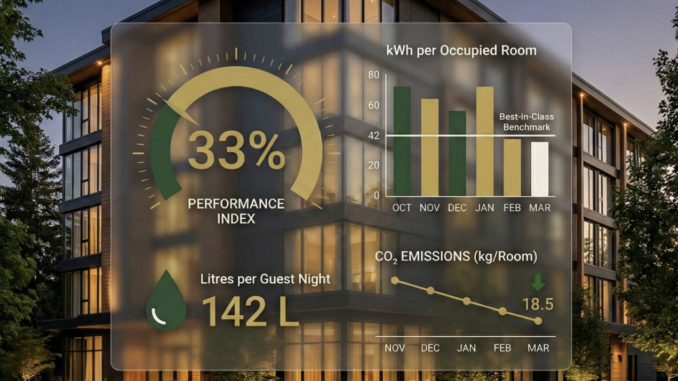
This is where performance intelligence is beginning to reshape the conversation around hotel efficiency. Rather than focusing solely on how individual pieces of equipment are operating, modern BMS platforms evaluate the performance of the building as a complete operational ecosystem, using its AI-driven Performance Index to benchmark energy and water performance against comparable hotels while adjusting for the variables that have the greatest influence on consumption, including occupancy, weather and location. Instead of presenting engineering teams with ever larger volumes of raw data, this approach transforms complex operational information into a clear performance score alongside practical recommendations, enabling hotel teams to identify where improvements can be made, understand the scale of the opportunity and track the impact of changes over time.
Importantly, this broader perspective extends beyond the assets traditionally managed by a Building Management System. Operational processes, maintenance practices, water efficiency initiatives and even behavioural changes among hotel teams all contribute to overall building performance, yet many fall outside the scope of conventional automation systems despite offering significant opportunities for savings.
Building on Existing Investments
Rather than replacing a Building Management System, modern platforms provides an additional layer of strategic oversight that helps hotels maximize the value of the investments they have already made. Independent benchmarking can highlight when control strategies require updating, identify situations where a BMS may no longer be delivering expected results and uncover opportunities for further savings that sit beyond the reach of equipment automation alone. Equally, for hotels without a traditional BMS, modern performance platforms provide an accessible and cost-effective way of identifying many of the same efficiency opportunities, enabling operators to make meaningful progress without the significant capital investment associated with a full building automation system.
As operating costs continue to rise and sustainability expectations become increasingly demanding, the hotels that achieve the greatest success are unlikely to be those with the most technology, but those that make the best use of it. Building automation will remain an essential foundation for efficient operations, yet the next stage of the industry’s evolution lies in combining that automation with continuous performance intelligence, ensuring that hotels are not simply controlling their buildings, but constantly improving the way they perform. By combining AI-powered benchmarking with practical operational guidance, modern performance platforms enable hotels to move beyond reactive utility management towards a culture of continuous performance improvement, helping operators reduce costs, strengthen ESG performance and maximize the return on both new and existing building technologies.
 Cedric Rodrigues is Co-Founder & Chief Product Officer of Cadae, a data-driven platform that helps hotels optimize energy and water performance, reducing operating costs while supporting sustainability goals. He is the architect behind Performance Hotel Insights, drawing from decades of hands-on experience in hotel operations and energy management. Having worked directly with international groups including Starwoods, Radisson, and Accor, Rodrigues understands the operational realities of hotel utilities management. His unique perspective ensures PHI addresses the practical challenges faced by hotel engineers and managers daily. Designed specifically for the hospitality sector, Cadae combines advanced benchmarking with practical, actionable guidance to help hotel teams identify inefficiencies, prioritize improvements, and maintain performance over time.
Are you an industry thought leader with a point of view on hotel technology that you would like to share with our readers? If so, we invite you to review our editorial guidelines and submit your article for publishing consideration.